










.avif)




Article Outline
Start your personalized GLP-1 program


How Fast Does Semaglutide Work: Timeline & Effects (2026)
You may have stepped on the scale and wondered how long it takes for semaglutide to produce measurable weight loss or type 2 diabetes management..
For most people, appetite begins to ease within the first 1–4 weeks. Noticeable weight loss often follows around week 4, with more significant changes unfolding between months 2–6 as your dose increases.
Still, no two timelines look the same.
In this guide, you’ll see what typically happens week by week, what changes to expect at each stage, and which factors may influence your pace of progress.
How Fast Does Semaglutide Work in Weight Loss
Here's what clinical evidence shows at each stage:
Let’s look in more detail at the estimated timelines for weight loss with semaglutide.
1. Initial Start: Weeks 1–4
This pre-therapy phase allows your body to adjust to the potential benefits and side effects of semaglutide.
The earliest and most common change you may experience in this phase is quieter "food noise." Food noise is the constant thoughts about food intake — cravings, what to munch next, or how often you should eat.
For people managing type 2 diabetes, this phase is also when early blood sugar improvements begin.
And the first four weeks require a dosage initiation of 0.25 mg once weekly, injected subcutaneously.
Read more: If you’re curious about what results may look like after one month, check out our guide to review real-world semaglutide before-and-after examples.
2. Mid-Term Effects: Weeks 5–16 (Months 2–4)
By the end of the first month, average weight loss is typically around 2–3%. From there, results begin to build more steadily.
In the STEP 1 trial, participants lost roughly 6–7% of their body weight by Week 12.
Weight loss continued through Week 16 as doses increased toward the full therapeutic level. Some individuals approached 8–10% reductions by the four-month mark, though results varied.
For someone starting at 200 pounds, a 6% reduction equals about 12 pounds. Individual outcomes depend on dose progression, consistency, and overall health.
During this phase, semaglutide is gradually increased from 0.25 mg to higher doses such as 0.5 mg, 1.0 mg, and 1.7 mg.
This stepwise approach reduces the risk of common side effects escalating into something serious. And your dose changes should always occur under medical supervision.
For a closer look at what's realistic in this window, see how much weight you may lose on semaglutide over 3 months.
Need help understanding your dose schedule? Here's a complete guide to semaglutide dosage.
3. Long-Term Effects: Months 5–15+ (Weeks 17–68)
By month 5, most people reach the full therapeutic dose of 2.4 mg. At this stage, appetite suppression is strongest, and weight loss becomes more consistent rather than dramatic week to week.
From here, progress builds steadily over time. Participants lost an average of 14.9% of their body weight after 68 weeks on the 2.4 mg dose.
For someone starting at 220 pounds, that equals roughly 33 pounds. In the same study, 86.4% of participants achieved at least 5% weight loss. For those with type 2 diabetes, this long-term phase is also associated with meaningful, sustained reductions in blood sugar levels.
Wondering how long you should stay on semaglutide? That depends on your goals and your doctor's guidance.
How Fast Does Semaglutide Work Compared to Other Weight Loss Medications
Let’s see how other options compare to semaglutide:
Tirzepatide, the active ingredient in Mounjaro and Zepbound, acts on both GIP and GLP-1 receptors, which explains its strong weight-loss effects.
Semaglutide, however, remains the most extensively studied GLP-1 medication for weight loss, with long-term data extending up to four years.
Liraglutide requires daily injections rather than weekly dosing, which some people find less convenient.
Metformin is more affordable and produces modest weight loss, typically 2–5%. It is not specifically approved for weight loss, but in some cases, it may support long-term metabolic maintenance.
Want a deeper breakdown? Compare semaglutide vs. tirzepatide, semaglutide vs. Mounjaro, or semaglutide vs. metformin.
Key Factors That Affect How Fast Semaglutide Works
1. Your Starting Weight and Body Mass Index
People with higher Body Mass Index (BMI) often lose more total weight in the first few months because a larger body mass creates a larger calorie deficit when appetite drops.
In the STEP 1 trial, participants had an average BMI of 37.9 and lost 14.9% of their body weight at 68 weeks on semaglutide 2.4 mg.
This shows that individuals with higher baseline BMIs can achieve substantial reductions over time.
While results vary from person to person, your starting BMI sets the baseline for all percentage changes.
2. Dose Titration Speed
Faster dose escalation generally leads to faster results but also increases the risk of side effects.
Your provider may personalize your semaglutide dosage schedule based on how your body responds.
Some people reach the full 2.4 mg dose ahead of the standard 17-week timeline. Others need longer.
3. Diet, Exercise, and Lifestyle
Pairing your semaglutide medication with balanced nutrition, regular physical activity, and stress management makes you achieve faster, more sustainable results.
You may not need a rigid diet plan. Even small shifts, such as increasing protein intake, eating fewer ultra-processed foods, and walking 30 minutes, can meaningfully accelerate your progress.
For practical guidance, explore this semaglutide diet plan.
4. Adherence and Consistency
Missing doses or inconsistent injection timing reduces how well semaglutide works.
The medication has a half-life of about 7 days, meaning its effects begin to taper toward the end of each weekly cycle.
Taking your injection on the same day each week to maintain steady blood levels.
Wondering if your medication isn't working as expected? Your provider may help adjust your approach.
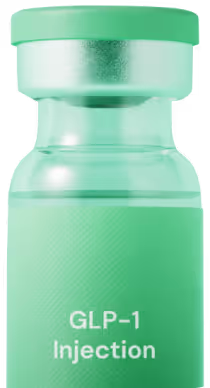
Ivy Rx offers personalized GLP-1 injections starting at $175 per month — which includes medical evaluation, dosing guidance, and ongoing provider support.

Possible Side Effects of Using Semaglutide for Weight Loss
1. Nausea
Nausea is the most common early reaction. It often shows up in the first few weeks or after a dose increase.
Eating smaller, lighter meals and avoiding greasy foods may reduce nausea. For most people, nausea fades within a few weeks at each dose level.
2. Digestive Changes (Diarrhea and Constipation)
Semaglutide slows stomach emptying, and this effect reduces your appetite, but it may also lead to diarrhea or constipation.
Staying hydrated and eating enough fiber often makes a noticeable difference. These symptoms usually settle as your body adapts.
3. Fatigue
Some people feel more tired than usual in the first month, particularly because they're eating less.
As your body adjusts to a lower-calorie intake, energy levels typically stabilize. Adequate protein intake, hydration, diet and exercise may help.
If you’re experiencing headaches on semaglutide, that's another common early side effect that typically improves as treatment continues.
When to Speak to a Doctor While Taking Semaglutide
See the doctor if you’re experiencing:
- No change in appetite or weight after 8–12 weeks.
- Unusual mood changes or lasting shifts in mental health.
- Signs of an allergic reaction, like swelling or trouble breathing.
- Severe or persistent nausea that doesn't improve after 2–3 weeks.
- Intense upper abdominal pain radiating to your back (possible pancreatitis).
- Sharp pain under your right rib cage after eating (possible gallbladder issue).
Your provider may adjust your dose or reassess your treatment plan to ensure it fits your needs. Always consulting your physician before taking a GLP-1 receptor agonist is the right approach to getting semaglutide.
Create a Personalized Weight Loss Program with Ivy Rx
How fast semaglutide works depends on proper dosing, medical guidance, diet and exercise.
Ivy Rx provides personalized GLP-1 injections starting at $175 per month, with medical evaluation, dosing guidance, and ongoing provider support included.
Treatment is delivered through a simple online process, and your subcutaneous medication ships directly to your door.
Ready to start? Get your personalized weight loss plan today. Or explore how Ivy Rx works and what's included in your program.

%25201.avif)

Ivy RX patients
Members of Ivy RX branded medications were paid for their testimonials.
- Wilding JPH, Batterham RL, Calanna S, Davies M, Van Gaal LF, Lingvay I, McGowan BM, Rosenstock J, Tran MTD, Wadden TA, Wharton S, Yokote K, Zeuthen N, Kushner RF; STEP 1 Study Group. Once-Weekly Semaglutide in Adults with Overweight or Obesity. N Engl J Med. 2021 Mar 18;384(11):989-1002. https://pubmed.ncbi.nlm.nih.gov/33567185/. DOI: 10.1056/NEJMoa2032183.
- Wharton S, Freitas P, Hjelmesæth J, Kabisch M, Kandler K, Lingvay I, Quiroga M, Rosenstock J, Garvey WT; STEP UP trial group. Once-weekly semaglutide 7·2 mg in adults with obesity (STEP UP): a randomised, controlled, phase 3b trial. Lancet Diabetes Endocrinol. 2025 Nov;13(11):949-963. https://pubmed.ncbi.nlm.nih.gov/40961952/. DOI: 10.1016/S2213-8587(25)00226-8.
- Ania M. Jastreboff, M.D., Ph.D., Louis J. Aronne, M.D., Nadia N. Ahmad, M.D., M.P.H., Sean Wharton, M.D., Pharm.D., Lisa Connery, M.D., Breno Alves, M.D., Arihiro Kiyosue, M.D., Ph.D., Shuyu Zhang, M.S., Bing Liu, Ph.D., Mathijs C. Bunck, M.D., Ph.D., and Adam Stefanski, M.D., Ph.D., for the SURMOUNT-1 Investigators. https://www.nejm.org/doi/full/10.1056/NEJMoa2206038.
- Fornes A, Huff J, Pritchard RI, Godfrey M. Once-Weekly Semaglutide for Weight Management: A Clinical Review. J Pharm Technol. 2022 Aug;38(4):239-246. https://pmc.ncbi.nlm.nih.gov/articles/PMC9272494/. doi: 10.1177/87551225221092681.
- Pi-Sunyer X, Astrup A, Fujioka K, Greenway F, Halpern A, Krempf M, Lau DC, le Roux CW, Violante Ortiz R, Jensen CB, Wilding JP; SCALE Obesity and Prediabetes NN8022-1839 Study Group. A Randomized, Controlled Trial of 3.0 mg of Liraglutide in Weight Management. N Engl J Med. 2015 Jul 2;373(1):11-22. https://pubmed.ncbi.nlm.nih.gov/26132939/. DOI: 10.1056/NEJMoa1411892.
- Apolzan JW, Venditti EM, Edelstein SL, Knowler WC, Dabelea D, Boyko EJ, Pi-Sunyer X, Kalyani RR, Franks PW, Srikanthan P, Gadde KM; Diabetes Prevention Program Research Group. Long-Term Weight Loss With Metformin or Lifestyle Intervention in the Diabetes Prevention Program Outcomes Study. Ann Intern Med. 2019 May 21;170(10):682-690. https://pubmed.ncbi.nlm.nih.gov/31009939/. DOI: 10.7326/M18-1605.
Related
Resources

What Does Semaglutide Do To Your Body?
Semaglutide is a drug similar to the endogenous GLP-1 peptide secreted from the intestinal L-cells. GLP-1 is released from the intestine and exh...
.avif)
Semaglutide 1 Month Results: Weight Loss, Side Effects & More
A full breakdown of Semaglutide results after 1 month. Understand its effects on weight loss, appetite control, and potential side effects.
.avif)
How Much Weight Can You Lose on Semaglutide in 3 Months?
How much weight can you lose with Semaglutide in 3 months? Explore realistic expectations, results from clinical studies, and tips to enhance your weight loss.