





.avif)


Article Outline
Start your personalized GLP-1 program


Does Semaglutide Need to Be Refrigerated Full Storage Guide
Yes, injectable semaglutide needs to be refrigerated, and the exact rule changes depending on which product you have. Novo Nordisk states that an Ozempic® pen stays between 36°F and 46°F until first use, then lasts 56 days at room temperature. Compounded semaglutide follows a different date, set by the pharmacy that prepared it.
This guide covers each product, what heat does to the drug, how to check a vial for damage, and how to fly with your medication.
Does Semaglutide Need to Be Refrigerated?
Injectable semaglutide needs refrigeration, and oral semaglutide does not. The table below shows the rule for each product sold in the United States.
Injectable Semaglutide (Ozempic® and Wegovy®)
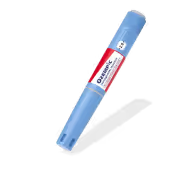
Both brand-name injections start in the refrigerator at 36°F to 46°F. According to the Ozempic® prescribing information, a new pen stays there until the expiration date on the label. Once you use it, you can keep it at 59°F to 86°F or back in the fridge, and you discard it after 56 days either way.
Wegovy® works differently because each pen holds one dose. The Wegovy® prescribing information says the pen can sit between 46°F and 86°F for up to 28 days before you remove the cap. You must protect it from light and keep it in the original carton until you inject. After the injection, the pen goes in a sharps container.
Compounded Semaglutide
Compounded semaglutide stays refrigerated at 36°F to 46°F, and the date that matters is the beyond-use date printed on your vial. That date is not a class-wide number. The pharmacy that prepared your vial assigns it under USP 797, based on how the preparation was made and tested.
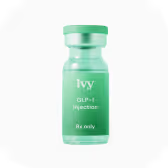
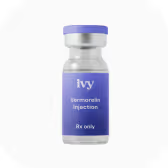
Ivy Rx ships its Personalized GLP-1 Injections, which are made in the USA, in temperature-controlled packaging, and every vial label carries your storage conditions and your beyond-use date. If your label is missing either one, message your care team before you inject.
Oral Semaglutide (Rybelsus®, Wegovy® Pill, and Ozempic® Pill)
None of the semaglutide tablets need refrigeration. Rybelsus® is stored at 68°F to 77°F, with short excursions allowed between 59°F and 86°F. The Wegovy® pill was approved in December 2025, and the Ozempic® pill followed, and both use the same room temperature range.
All three share one instruction that people miss. Keep the semaglutide tablets in the bottle they came in, in a dry place, and do not move them to a pill organizer. The tablets absorb moisture, which is why the original bottle matters.
What Happens If Semaglutide Is Not Refrigerated?
Heat breaks semaglutide apart, and the damage is invisible at first. Semaglutide is a 31-amino-acid peptide with a fatty acid chain attached, so it is far more fragile than a tablet.
Researchers writing in the European Journal of Pharmaceutics and Biopharmaceutics ran semaglutide through thermal stress at 25°C, 40°C, and 60°C for 28 days, then at 80°C for a week. The study identified 13 separate degradation impurities and found that pH drives how fast the peptide breaks down. Six of those impurities appeared under every condition tested.
A second paper in the Journal of Peptide Science pinned down where semaglutide is most vulnerable. Degradation rose sharply between pH 4.5 and 5.5, which sits at the peptide's isoelectric point of 5.4. The authors concluded that a finished semaglutide product should be formulated above pH 7.0 to stay stable.
Semaglutide also clumps together. Work published in Biomacromolecules used cryogenic electron microscopy and X-ray scattering to show that semaglutide slowly forms micelles in solution, alongside a small population of needle-shaped fibrils. That research found the clumping changed how the drug crossed a gut cell membrane model.
I Accidentally Left My Semaglutide Out Overnight. What Should I Do?
Start by finding out how warm the room got, because 86°F is the line that decides what you do next. Novo Nordisk instructs patients not to use any of its products that have been exposed to temperatures above 86°F and not to use any product that has been below 36°F.
If the room stayed under 86°F and you have an Ozempic® pen, the pen is still usable. There is a catch that most articles skip. Novo Nordisk states that once Ozempic® has been exposed to any temperature above 46°F, it must be used or discarded within 56 days. An unopened pen left on the counter has started that clock, even though you never injected from it.
For a compounded vial, call the pharmacy rather than guessing. Our guidance on compounded semaglutide expiration states that the medication tolerates room temperature below 86°F for up to 24 hours, with refrigeration preferred. Your vial label and your pharmacy are still the final word, because concentration and formulation vary.
How Long Does Compounded Semaglutide Last in the Fridge?
Two separate deadlines apply to a compounded vial, and the earlier one wins. Almost every article covering this topic mentions only one of them.
The first deadline is the beyond-use date on the label. Under USP <797>, a compounding pharmacy assigns that date based on its category of compounding, whether the preparation was terminally sterilized, whether sterility testing was performed and passed, and the storage temperature.
Refrigerated limits published in USP 797, as reproduced in Florida's sterile compounding inspection form, run from four days at the low end to 120 days at the high end.
Here is how those refrigerated limits break down.
The second deadline starts when you first push a needle through the stopper. USP <797> caps a multi-dose container at 28 days after that first puncture, unless the manufacturer specifies something shorter. For a compounded multi-dose vial, you use the assigned beyond-use date or 28 days, whichever comes first.
That is why the "90 days" figure repeated across the internet is misleading. A 90-day refrigerated date is possible, but only for a Category 3 preparation that passed every required test. Once you puncture that vial, you still have 28 days.
How to Tell If Your Semaglutide Has Gone Bad
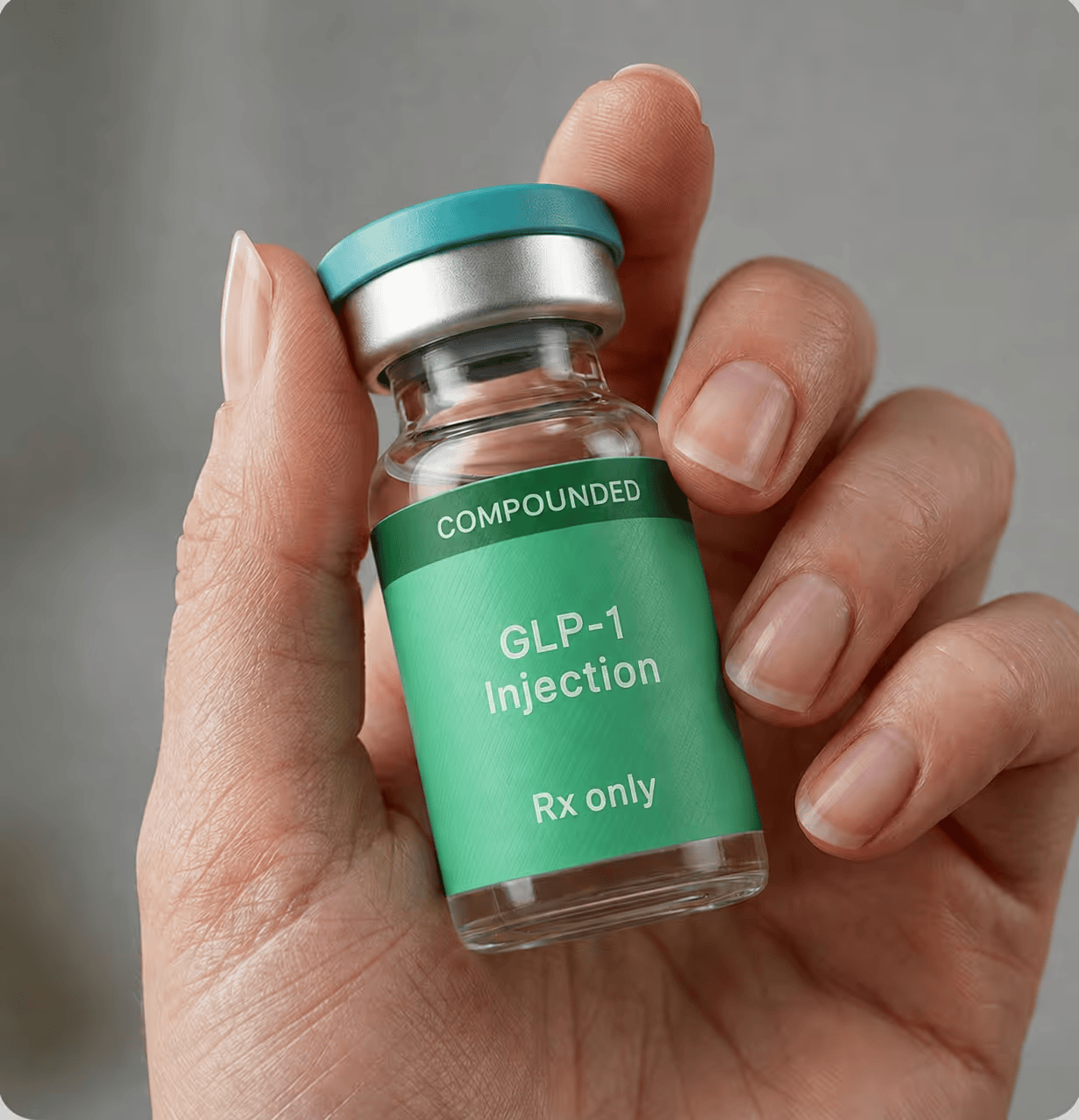
Hold the pen or vial up to a good light and look at the liquid before every dose. Novo Nordisk tells patients to inspect the product for clumping, precipitation, or a change in color or clarity, because any of those can mean the drug has lost potency.
Healthy semaglutide is clear and colorless, like water. Check for these signs instead.
- Cloudiness or a hazy look where the liquid used to be clear
- Any yellow, brown, or off-white tint
- Floating specks, strands, or particles settled at the bottom
- Frost, ice crystals, or a slushy texture from freezing
- A cracked vial, a bulging stopper, or a loose seal
Two situations mean you discard the medication even when it looks perfect. The first is a date that has passed, whether that is an expiration date, a beyond-use date, or your 28-day or 56-day in-use window. The second is a known temperature excursion above 86°F or below 36°F.
Before you draw a dose, our walkthrough on how to inject semaglutide shows the inspection step in sequence. If you are new to injections, this tutorial video covers the full process.
How to Travel With Semaglutide
Pack your medication in a temperature-controlled container and never in checked luggage. Cargo holds can drop below freezing, and freezing ruins semaglutide permanently. Your medication should arrive refrigerated.
The Transportation Security Administration allows larger amounts of medically necessary liquids in reasonable quantities for your trip, above the usual 3.4-ounce limit. You have to declare them to an officer at the checkpoint for inspection.
Cooling supplies get their own exception. TSA states that medically necessary gel ice packs are allowed in reasonable quantities regardless of whether they are frozen, melted, or slushy. Tell the officer at the checkpoint so they can inspect them.
Use these steps for a smooth trip.
- Pack the medication in an insulated case with a gel pack, keeping the vial or pen from touching the frozen pack directly.
- Keep everything in the original carton or pharmacy packaging with the label attached.
- Declare the medication and the gel packs before screening starts.
- Ask your hotel for a room refrigerator or fridge storage at the front desk when you arrive.
- Bring a few extra days of supply in case your return is delayed.
Storage should not be guesswork. Ivy Rx ships Personalized GLP-1 Injections in temperature-controlled packaging, with the beyond-use date and storage conditions printed on every vial. Pricing runs as low as $97 per month on the 12-month plan, billed upfront, with a Rate Lock Guarantee so your price doesn’t change as the dose goes up.
Store It Right, and Your Semaglutide Will Work the Way It Should
Two numbers decide almost every storage question you will face. Keep injectable semaglutide between 36°F and 46°F, and treat 86°F as the point where the medication is no longer safe to use.
Everything else comes down to reading your own label. Brand-name pens carry a printed expiration date and a fixed in-use window, while compounded vials carry a beyond-use date assigned by the pharmacy that made them. When your label and a general article disagree, the label wins.
If you are on compounded semaglutide through Ivy Rx and have questions about storage or expiration, our care team is available to help.
FAQs
Can You Freeze Semaglutide to Make It Last Longer?
No. Freezing destroys semaglutide, and the damage cannot be reversed by thawing it. Novo Nordisk instructs patients not to use any product exposed to temperatures below 36°F, because freezing causes loss of potency, clumping, frosting, and precipitation. This applies to brand-name pens and compounded vials equally. Discard any medication you find frozen and contact your pharmacy for a replacement.
Is It Safe to Use Semaglutide That Was Left in a Hot Car?
Treat it as unusable and call your pharmacy. Novo Nordisk states that its products should not be used after exposure to temperatures above 86°F, and a parked car in the sun passes that point quickly. You cannot tell by looking, because heat degradation produces impurities the eye cannot see. Do not inject a dose to find out.
Does Semaglutide Need to Be Refrigerated During Shipping?
Yes, and a reputable clinician handles this for you. Ivy Rx ships in temperature-controlled packaging with free delivery, which keeps the vial in range during transit. Put your package in the refrigerator as soon as it arrives rather than leaving it at the door. If a package sat outside in the heat, message your care team before using it.
What Is the Best Way to Store Semaglutide Pens Long-Term?
Keep unopened pens in the main body of the refrigerator between 36°F and 46°F, not in the door, where the temperature swings every time you open it. Keep them away from the cooling element at the back, which can freeze them. Leave the pen in its original carton to block light, keep the cap on, and store it without a needle attached.
Disclaimer: Storage temperatures, in-use windows, beyond-use date rules, prescribing-label instructions, travel screening rules, and pricing in this article were curated in August 2026 and may change. Your product label and pharmacy instructions take priority over general guidance. Always confirm current storage and program terms with a licensed clinician before starting treatment.

%25201.avif)

Ivy RX patients
Members of Ivy RX branded medications were paid for their testimonials.
- https://pubmed.ncbi.nlm.nih.gov/40490042/
- https://pubmed.ncbi.nlm.nih.gov/40635175/
- https://pmc.ncbi.nlm.nih.gov/articles/PMC12152837/
- https://www.floridahealth.gov/licensing-and-regulation/enforcement/inspection-program/_documents/Sterile_Cmpd_Inspection_Form.pdf
- https://www.tsa.gov/travel/security-screening/whatcanibring/items/medications-liquid
- https://www.tsa.gov/travel/security-screening/whatcanibring/items/gel-ice-packs
Related
Resources

Semaglutide Compounding Pharmacy Cost: 2026 Price Guide
Wondering about compounded semaglutide costs? Get exact pricing, insurance coverage details, and money-saving tips in our complete guide.

Complete Guide to Semaglutide Dosage For Weight Loss: Dosage Schedule & Adjustments (+Chart)
Ensure proper semaglutide usage with our dosage chart, adjustment tips, and helpful advice on what to do when you miss a dose.

Average Cost of Semaglutide Injections What You'll Pay
Semaglutide injections cost roughly $1,000 to $1,350 a month brand-name, or $150 to $500 compounded. See the full 2026 breakdown.