






.avif)



Article Outline
Start your personalized GLP-1 program


Side Effects of Microdosing GLP‑1 You Need to Know (2026)
Many people explore GLP-1 microdosing to manage side effects while continuing treatment. Lower doses may feel easier to tolerate, especially when you’re balancing work and daily life.
But a lower dose doesn’t guarantee fewer side effects.
Even small doses of Semaglutide or Tirzepatide may slow digestion and alter appetite signals.
This guide explains which side effects are common during microdosing, which symptoms need medical attention, and why provider oversight still matters, even at lower doses.
What Microdosing GLP-1 Is
Microdosing with GLP-1 involves using doses below the standard prescribing schedule or spacing dose increases more gradually than in clinical trials.
It is typically provider-guided or patient-driven, often chosen to improve tolerability, manage side effects, reduce cost, or support weight maintenance.
Although the side effects may be milder than with full-dose GLP-1 medications, they do not disappear. GLP-1 medications may cause side effects like:
- Reduced appetite signals.
- Slowed stomach emptying.
- Changes in how the body processes food.
While the FDA has issued guidance on microdosing in drug research, there is no FDA-approved microdosing protocol for GLP-1 medications. So these medications are prescribed off-label.
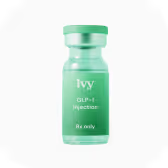
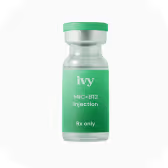
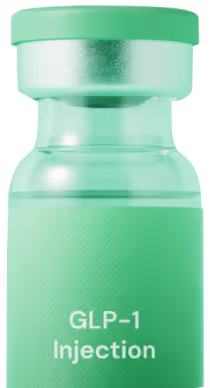
Personalized GLP-1 injections from Ivy Rx let providers tailor your dose to your tolerance, starting low and adjusting based on your actual response.
Mild and Common Side Effects Of Microdosing GLP-1
1. Mild nausea
GLP-1 medications slow stomach emptying, which means food may stay in the stomach longer than usual.
This sensation is often temporary and may ease as your body adapts to the medication and the dose stabilizes.
The intensity varies. Some people barely notice it, while others feel it more around meals.
2. Bloating and gas
You may notice mild bloating while microdosing GLP-1. These medications slow down digestion, which can make your stomach feel tighter.
Gas may move through the stomach and intestines more slowly than usual, which can contribute to bloating or belching.
These symptoms are often mild and tend to improve as the body adjusts. So eating slowly, avoiding carbonated drinks, and taking short walks after meals may help.
You can read our clear breakdown of how Semaglutide works in your body.
3. Changes in bowel habits
Because GLP-1 medications affect how quickly food moves through the digestive tract, bowel motility may slow or become irregular in some individuals, especially during the early weeks of treatment.
This experience varies. Some people may experience minimal or digestive disruption, even as their weight loss progresses. Others may notice temporary changes that improve as their bodies adapt to the medication.
4. Reduced appetite
While this may be an intended effect of taking GLP-1s, your appetite may drop so low that you struggle to meet nutrition needs.
If this is the case, set eating reminders to focus on protein-dense foods like Greek yogurt, eggs, and lean meat.
Download our detailed semaglutide diet plan to support your results week by week.
5. Fatigue and headaches
Clinical studies on GLP-1 medications show that fatigue and headaches may occur as appetite decreases, digestion slows, and calorie or fluid intake changes. These effects are also linked to shifts in blood sugar as the body adapts to treatment.
Because microdosing uses lower-than-standard amounts of the same medications, some people may still notice fatigue or headaches, though they are often reported as milder compared to full therapeutic doses.
Learn more about Semaglutide headaches, including causes, prevention, and treatment options.
Moderate Side Effects of Microdosing GLP-1
1. Persistent nausea with vomiting
Taking GLP-1 medications may cause some people to experience ongoing nausea that occasionally progresses to vomiting, even at lower doses.
This can increase the risk of dehydration or electrolyte imbalance if it continues unchecked.
And while lower doses may reduce this risk, they do not eliminate it entirely.
For context on managing responses, read about Semaglutide not working or weight loss plateaus.
2. Worsening reflux or GERD
Some people report heartburn or reflux-like symptoms when using GLP-1 medications. This can happen because GLP-1 slows digestion, which may keep the stomach fuller for longer and increase post-meal discomfort.
Because the same digestive effects still occur when you take a microdose, reflux-like symptoms may still show up for some people, though they are often milder and less frequent than with standard doses.
3. Dizziness or lightheadedness
Some people may feel lightheaded, especially when standing up quickly. This may be due to reduced fluid intake, changes in blood pressure, or shifts in blood sugar as appetite and digestion slow.
Staying hydrated and maintaining electrolytes may help. If you take other medications that affect blood sugar or blood pressure, monitoring becomes more important.
Serious Side Effects of Microdosing GLP-1
Serious side effects are rare but not impossible. If they occur, see a medical provider for prompt diagnosis.
1. Abdominal pain (pancreatitis)
In clinical trials, uncommon cases of pancreatitis have been reported rarely with GLP-1 medications.
When it occurred, it was most often in people with existing risk factors, such as a prior history of pancreatitis or gallstones.
Lower doses may reduce strain on the digestive system, but they do not remove risk.
Medical supervision remains important at any dose. If you experience a related symptom, treat it as an emergency.
2. Severe dehydration and kidney damage
Ongoing vomiting or diarrhea can lead to dehydration while using GLP-1 medications. When fluid intake drops too low, the kidneys may become stressed and, in rare cases, injured.
Warning signs include very dark urine, lightheadedness when standing, a fast heartbeat, or unusual confusion. These symptoms suggest your body is not maintaining normal fluid balance.
If you are unable to keep fluids down for more than 24 hours, seek medical care. Treatment may include IV fluids and blood tests to check kidney function.
3. Vision changes (diabetic patients)
GLP-1 therapy has been linked to temporary vision changes in some people with diabetes, especially when blood sugar improves quickly.
And studies show that Semaglutide has a direct association with causing diabetic retinopathy complications in patients with type-2 diabetes
For context on safety, review the guidance on compounded Semaglutide and Tirzepatide safety.
How to track microdosing GLP-1 side effects
Tracking side effects helps catch small issues early, before they interfere with treatment.
1. Start a daily symptom journal
Keeping a treatment journal from the start makes tracking effective:
- Record injection date and time.
- Note symptoms within the next 24–48 hours.
- Rate severity on a 1–10 scale, and communicate observation to your health provider.
Patterns matter when tracking possible side effects. Some effects peak 1 to 2 days after injection. Others fade before the next dose. So your recorded observations may help your provider guide dose adjustments.
2. Monitor key weekly signals
- Weight: Check once weekly, on the same day and at the same time.
- Hydration: Aim for pale yellow urine.
- Food intake: Ensure consistent protein intake.
- Bowel habits: Contact your provider if there’s no movement for 3 days.
3. Know when to call your provider
Contact your provider promptly if you notice:
- Ongoing vomiting.
- Dark urine or low urine output.
- Dizziness that affects daily activities.
- Severe or worsening abdominal pain.
Seek urgent care immediately for:
- Severe abdominal pain that radiates to the back.
- Inability to keep fluids down for 24 hours.
- Vision changes or trouble breathing.
You can find a treatment that suits your weight loss needs with Ivy Rx's medical team for ongoing support and dose optimization.
4. Schedule regular provider check-ins
Monthly check-ins during the first few months allow for symptom review, dose refinement, and lab monitoring when needed. This level of oversight is built into care at Ivy Rx, with every personalized GLP-1 plan.
5. Share your complete medication list
Tell your provider everything: prescriptions, supplements, and herbal products. And never adjust doses without medical guidance. Call before increasing, decreasing, or skipping doses.
Review key factors to consider when selecting the right medical weight-loss clinic or prescription pill.
Find the right GLP-1 weight loss option with Ivy Rx
Weight-loss treatment is not one-size-fits-all. Some people do well on standard GLP-1 dosing. Others need a lower, more gradual approach to manage side effects or support long-term maintenance.
Ivy Rx offers both personalized GLP-1 injections and microdose GLP-1 options, so your treatment can match your goals, tolerance, and budget.
Every plan includes medical evaluation, provider-guided dosing, and ongoing support as your body responds. Medications are delivered directly to your door, with clear pricing.
So whether you need full dosing or a mild starting point, Ivy Rx makes it easier to access supervised GLP-1 care without delays.
For deeper context, you can also review real microdosing GLP-1 experiences across different dose levels.

%25201.avif)

Ivy RX patients
Members of Ivy RX branded medications were paid for their testimonials.
- https://www.nejm.org/doi/full/10.1056/NEJMoa2032183. Accessed 22nd of January, 2026.
- ai CX, Nishimura A, Baxter S, Goetz K, Hribar M, Toy B, Barkmeier A, Wang S, Swaminathan S, Flowers A, Brown E, Xu B, Chen J, Chen A, Leng T, Boland M, Alshammari T, Bu F, Falconer T, Martin B, Westlund E, Mathioudakis N, Zhang L, Fan R, Wilcox A, Lai A, Stocking JC, Xie Y, Lee LH, Dorr D, Humes I, McCoy D, Adibuzzaman M, Areaux R Jr, Brash J, Weiskopf N, Morgan-Cooper H, Desai P, Tran D, Rustam Z, Zhu G, Swerdel J, Sena A, Nagy P, Suchard M, Schuemie M, Hripcsak G, Ryan P. Semaglutide and diabetic retinopathy: an OHDSI network study. BMJ Open Diabetes Res Care. 2025 Nov 4;13(6):e005424. https://pmc.ncbi.nlm.nih.gov/articles/PMC12587949/. doi: 10.1136/bmjdrc-2025-005424.
Related
Resources
.jpg)
Remedy Meds vs Mochi Which Is Better for Weight Loss
RemedyMeds and Mochi differ in pricing, medications, provider support, and membership structure. Compare both to find the right weight-loss option

Peptides for Weight Loss Explained Which Ones Actually Work
Peptides for weight loss are short amino acid chains that curb appetite and slow digestion. FDA approved options include Wegovy, Zepbound, and Saxenda.

Liraglutide Cost in 2026 Prices With & Without Insurance
Liraglutide costs $500 to $1,700 per month without insurance. Generic versions and discount cards can cut costs to under $500 per month.