






.avif)



Article Outline
Start your personalized GLP-1 program


AOD 9604 vs Semaglutide: Key Differences Explained
People searching AOD 9604 vs semaglutide are usually looking for a fat loss option that does not blunt appetite. The short answer is that only one of the two has human trial data supporting weight loss.
Semaglutide reduces appetite and slows digestion, and large trials measured the result. AOD 9604 targets fat metabolism instead, and its largest human trial did not show a meaningful effect. This guide compares how each one works, what the studies found, the safety picture, and how access and cost differ.
AOD 9604 vs. Semaglutide: A Quick Overview
What Is AOD 9604?
AOD 9604 is a synthetic peptide built from the last 16 amino acids of human growth hormone, with an added tyrosine for stability. Monash University researchers in Australia developed it in the 1990s, and Metabolic Pharmaceuticals took it into trials.
The design goal was narrow. The team wanted the fat-mobilizing part of growth hormone without the effects on growth and blood sugar.
At a glance:
- Fragment of human growth hormone, not a hormone itself
- No FDA approval for any use, anywhere in the world
- Development for obesity stopped in 2007
- Banned by the World Anti-Doping Agency
People who reach this topic through anti-aging peptides often compare it with other options. Our peptides range lists what is actually available with a prescription.
What Is Semaglutide?
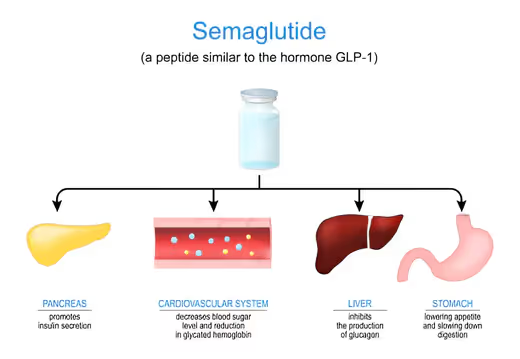
Semaglutide is a GLP-1 receptor agonist that copies a gut hormone your body already makes after meals. It reduces appetite, slows how quickly the stomach empties, and helps regulate blood sugar.
Novo Nordisk sells it under three brand names. Ozempic® is approved for type 2 diabetes, Rybelsus® is the oral diabetes version, and Wegovy® is approved for chronic weight management, per its FDA label. Wegovy® is now available as both a weekly injection and a daily tablet.
At a glance:
- FDA-approved, with published phase 3 trial data
- Weekly subcutaneous injection or a daily tablet
- Works by reducing appetite rather than by targeting fat cells
- Available by prescription only
Understanding what semaglutide does to your body helps set expectations, because the effects on blood sugar and digestion build over months rather than days. A prescription follows an eligibility review, which is where getting semaglutide starts for most people.
Similarities Between AOD 9604 and Semaglutide
The two have less in common than the search comparison suggests, but a few points overlap.
How AOD 9604 and Semaglutide Work Differently
The mechanisms are not related. One acts on the brain and gut, while the other acts on fat tissue.
Because semaglutide changes appetite, meal planning changes with it. A GLP-1 diet built on protein and smaller portions eases nausea, and microdosing semaglutide keeps doses low for people who react strongly to side effects.
Weight Effects Compared
This is where the two separate most clearly.
Semaglutide. In the STEP 1 trial, 1,961 adults with overweight or obesity took either semaglutide 2.4 mg weekly or placebo for 68 weeks. Mean body weight fell 14.9% with semaglutide and 2.4% with placebo. That works out to about 15.3 kg against 2.6 kg.
AOD 9604. A 12-week trial found that people taking 1 mg a day lost an average of 2.6 kg, against 0.8 kg on placebo. The larger follow-up trial did not repeat that result. A review in Current Cardiology Reviews records that development stopped in 2007 because the peptide failed to produce significant weight loss in a 24-week trial of 536 people.
The gap is large, and the quality of evidence differs as well. Semaglutide has published phase 3 data. The AOD 9604 trial that failed was never published in a peer-reviewed journal.
Trial averages hide a wide spread between individuals. Semaglutide weight loss reviews describe results running from modest to well above the trial mean.
Side Effects Comparison
The two have very different side effect profiles, mostly because they act on different systems.
AOD 9604
Across six randomized, double-blind, placebo-controlled trials, AOD 9604 was well tolerated. The published safety review reports no drug-related serious adverse events and no drug-related withdrawals.
It did not raise IGF-1 levels, and glucose tolerance testing showed no negative effect on carbohydrate metabolism. The highest dose tested, 54 mg, was linked to a higher rate of adverse events than lower doses.
That safety record comes with an important limit. It covers short trials of a compound that never reached approval, so long-term data in humans does not exist.
Semaglutide
Nausea and diarrhea are the most common effects, and both were usually mild to moderate and settled with time in STEP 1. Discontinuation because of gastrointestinal effects happened in 4.5% of the semaglutide group against 0.8% on placebo.
The FDA label also carries a boxed warning about thyroid C-cell tumors seen in rodents. Pancreatitis, gallbladder disease, and kidney problems from dehydration are less common but documented.
Most people regain weight after stopping, and semaglutide withdrawal symptoms include appetite returning within weeks of the last dose.
Regulation, Access, and Cost
Regulatory status: Semaglutide is FDA-approved and sold under brand names with published labels. AOD 9604 has no approval from any major health authority, and it is banned by the World Anti-Doping Agency, so athletes in tested sports cannot use it.
Access: Semaglutide requires a prescription from a licensed clinician, who reviews your history and sets the dose. AOD 9604 reaches people through compounding channels and online sellers, with far less oversight of what is in the vial.
Cost: Semaglutide has published prices across several channels. AOD 9604 pricing is not published in any standard way, which makes budgeting difficult and makes supply quality harder to judge.
Ivy Rx operates on the regulated side of that line. Your prescription comes from a licensed United States clinician, and your medication is made in the USA, prepared in a state-licensed pharmacy that is independently verified in FDA-registered labs for potency, sterility, endotoxins, and pH.
Our pricing is transparent and published, and our Rate Lock Guarantee means the price stays the same at every dose. Titrating up never changes what you pay.
Cash-pay prices for semaglutide without insurance are published and easy to compare against each other. Questions about whether compounded semaglutide is safe come down to the pharmacy and the oversight behind it.
How AOD 9604 and Semaglutide Are Administered
Dosing differs in frequency, in size, and in how well established the schedule is.
AOD 9604
There is no approved dosing schedule, because no regulator has reviewed one. Trials tested oral, intravenous, and subcutaneous routes across a wide dose range.
Anyone considering it should treat any dosing chart found online as unverified. Talk to a licensed clinician before using a compound with no approved label.
Semaglutide
Semaglutide starts low and increases in steps to reduce nausea during the first weeks. You inject once a week on the same day, at any time of day, with or without food.
Rotate the injection site with each dose. Technique matters more than which site you pick, and injecting semaglutide into the fat layer rather than muscle keeps absorption steady. The step-up semaglutide dosage schedule raises the amount every four weeks.
Can AOD 9604 and Semaglutide Be Used Together?
No trial has tested the two together in people. There is no published safety or efficacy data on the combination.
Any decision to combine treatments belongs with a qualified clinician who can manage dose changes and watch for interactions. Adding an unapproved peptide to an approved medicine also makes it difficult to tell which one caused a side effect.
If your reason for asking is that semaglutide feels too strong, a lower dose is a better first step than adding a second compound. Your clinician can adjust the titration schedule instead.
Who Might Consider AOD 9604 or Semaglutide?
- People who want proven weight loss: Semaglutide, which has published phase 3 trial results
- People who cannot tolerate appetite suppression: Semaglutide at a lower dose, discussed with a clinician
- People researching fat metabolism: AOD 9604, as a research topic rather than a treatment
- People who want clinician oversight: Semaglutide, since it is prescribed and monitored
People who cannot take a GLP-1 often look at a GLP-1 alternative such as metformin. Most peptides for weight loss remain unproven in human trials, which is the same problem AOD 9604 has.
Who Should Not Take AOD 9604 or Semaglutide?
- Anyone with a personal or family history of medullary thyroid carcinoma or MEN 2: Semaglutide is contraindicated
- Anyone pregnant, planning pregnancy, or breastfeeding: Neither is appropriate
- Athletes in tested sport: AOD 9604 is on the World Anti-Doping Agency banned list
- Anyone with a history of pancreatitis: Raise it with your clinician before starting semaglutide
Start With What Is Proven and Get a GLP-1 Plan From Ivy Rx
Ivy Rx connects you with a licensed United States clinician who reviews your history and sets a dose that fits you. Our Personalized GLP-1 Injections are made in the USA and start as low as $97 a month on a 12-month plan billed upfront in full, as of August 2026.
Our Rate Lock Guarantee holds that price at every dose, so moving up your titration never raises your bill. Shorter plans are also available, no insurance is needed, and treatment is HSA and FSA eligible.
FAQs
Is AOD 9604 the Same as Semaglutide?
No. AOD 9604 is a fragment of human growth hormone. Semaglutide is a GLP-1 receptor agonist, and the two act on completely different systems.
Is AOD 9604 FDA-Approved?
No. AOD 9604 has no FDA approval for obesity or any other use, and its obesity development program ended in 2007.
Which Is More Effective for Weight Loss, AOD 9604 or Semaglutide?
Semaglutide. STEP 1 recorded a mean 14.9% weight loss over 68 weeks, while the largest AOD 9604 trial failed to show significant weight loss.
Can AOD 9604 and Semaglutide Be Used Together?
Unknown. No published trial has tested the combination in people, so no safety or efficacy data exists.
What Is AOD 9604 Used For?
Nothing approved. It was developed as an obesity treatment, and it is now used mainly as a research compound.
Disclaimer: Clinical trial figures, prescribing-label details, regulatory status, dosing information, side effect data, and pricing in this article were curated in August 2026 and may change. Trial averages do not guarantee individual results. Always confirm current prescribing information, eligibility requirements, and program terms with a licensed clinician before starting treatment.

%25201.avif)

Ivy RX patients
Members of Ivy RX branded medications were paid for their testimonials.
Related
Resources

5-Amino-1MQ vs Semaglutide: Key Differences For Weight Loss (compared)
Compare 5-amino-1MQ vs semaglutide, including how they work, metabolic effects, and who each may be suited for. Learn the core similarities and differences in...
Semaglutide vs Tirzepatide for Weight Loss: Pros, Cons, and Side Effects
Semaglutide vs Tirzepatide: Which one offers the best weight loss results? Explore key differences in side effects, cost, and effectiveness.

Semaglutide Compounding Pharmacy Cost: 2026 Price Guide
Wondering about compounded semaglutide costs? Get exact pricing, insurance coverage details, and money-saving tips in our complete guide.