





.avif)


Article Outline
Start your personalized GLP-1 program


Microdosing Semaglutide 101: How it Works, Benefits & Risks
Microdosing semaglutide is now a trending topic. You may have seen mentions on TikTok, Reddit, Facebook, or other telehealth forums.
People are counting pen clicks and relying on micro amounts of the same therapy that helped STEP 1 trial participants lose nearly 15% of their body weight.
Doses people experiment with, sometimes as low as 0.05 mg, fall far below any level studied for therapeutic benefit yet the appeal is understandable given brand-name costs of $900–$1,600/mo and frequent GI side effects.
This guide covers what the science shows, who microdosing might suit, and where the real risks are.
What Is Semaglutide?
Semaglutide is a GLP-1 receptor agonist that mimics a natural gut hormone. It slows gastric emptying, reduces appetite signals in the brain, and improves insulin sensitivity.
It's delivered as a once-weekly subcutaneous injection; a small needle into the fat layer of the skin making it easy and painless to self-administer at home.
In the STEP 1 trial, participants on the full 2.4 mg weekly dose lost 14.9% of their body weight over 68 weeks, with 86% losing at least 5%.
That efficacy is what makes the microdosing question so complicated.
What Does "Microdosing" Mean in This Context?
Microdosing semaglutide means intentionally staying below standard therapeutic levels.
The usual starting dose for semaglutide is 0.25 mg for the first four weeks. After that, providers gradually increase it to 0.5 mg, then to 1 mg or higher. This process is called titration.
A microdosing approach stays below the standard 0.25 mg starting dose and often avoids moving up at all.
For the standard semaglutide dose, the 0.25 mg dose is intended as a pre-therapy step, not a long-term treatment level.
Microdosing, in contrast, uses a smaller dose as the primary strategy rather than progressing to full therapeutic levels.
For a closer look at how the standard protocol compares, see our GLP-1 microdosing schedule guide.
And if you wish to learn about the physiological effects of semaglutide, at any dose, see what semaglutide does to your body.
Why Are People Microdosing Semaglutide?
There are three practical reasons driving this microdosing trend.
Side Effects Push People Off Standard Doses
Some people choose microdosing because higher doses trigger nausea, vomiting, bloating, or stomach discomfort.
By staying at a very low dose, they hope to maintain mild appetite suppression while avoiding the side effects that often occur with dose increases.
Maintenance After Weight Loss
One of the strongest arguments for lower ongoing doses comes from what happens after stopping treatment. In the STEP 4 trial, participants who discontinued semaglutide regained a meaningful portion of the weight they had lost.
Because of this, some people choose to stay on a lower “maintenance” dose rather than stop completely.
The idea is to preserve appetite control and reduce the risk of regain, while minimizing side effects and long-term cost.
Cost and Accessibility
The average cost of brand-name semaglutide ranges from $900 to $1,600 per month without insurance. Most insurance plans do not cover GLP-1 medications for weight loss.
Microdosing stretches medication further, a quarter of the standard dose means roughly four times the duration per pen.
Ivy Rx's microdose GLP-1 injections offer a structured, affordable alternative starting at $155 per month.
For a full breakdown, see our guide on microdosing GLP-1 costs. For what to expect early on, see the semaglutide before-and-after: 1 month.
Comparison of Popular Semaglutide Microdosing Schedules
There is no standard FDA-labeled “microdosing” schedule for semaglutide.
Biweekly dosing also has emerging mathematical support, since semaglutide's long half-life means less frequent dosing doesn't proportionally reduce drug exposure.
For real patient experiences across these approaches, see microdosing GLP-1 reviews.
Potential Benefits of Microdosing Semaglutide
These are potential benefits based on clinical reasoning and early data, not proven outcomes from randomized trials.
Gentler Appetite Control
Full-dose semaglutide can eliminate hunger entirely; some patients describe losing the ability to enjoy food.
Microdosing may produce a subtler effect: reduced cravings without food aversion.
That gentler signal can make it easier to build lasting eating habits rather than depending on the medication to do all the work.
Fewer GI Side Effects
Semaglutide's GI side effects are dose-dependent.
Lower doses logically reduce exposure to nausea, bloating, and digestive distress especially during the escalation phase, where most side effects concentrate.
Muscle and Facial Volume Preservation
Rapid weight loss on full-dose semaglutide carries a risk of muscle loss and facial volume depletion, commonly referred to as the "Ozempic face".
Slower, more gradual weight loss from microdosing may help preserve lean mass, though this hasn't been confirmed in controlled studies.
A Sustainable Long-Term Path
The STEP 5 trial showed that semaglutide maintains its effects over two years with continued use.
If you need to stay on a GLP-1 indefinitely, finding the lowest effective dose reduces medication burden and cost, making long-term adherence more realistic.
Learn more about the benefits of microdosing GLP-1, or explore Ivy Rx's personalized GLP-1 injections for flexible dosing under clinical guidance.
Risks, Limitations & Important Warnings
Here are the possible risks and limitations of microdosing semaglutide.
Sub-Therapeutic Results
Dose matters. Spending months on a level too low to meaningfully activate GLP-1 receptors may delay real progress.
In the STEP trials, clinically significant weight loss occurred at therapeutic doses of 1.0 mg and above.
The 0.25 mg starting dose was designed as a short adjustment phase, not a long-term treatment target.
Dosing Errors
Microdosing often relies on estimating partial doses. Some people count pen “clicks.” Others draw small amounts with insulin syringes.
Both methods increase the chance of measurement error. Very small volumes are harder to measure accurately, increasing the risk of underdosing or exceeding the intended dose.
No Long-Term Safety Data
There are clinical trials on semaglutide dosage protocols, but no published study on microdosing semaglutide.
Working with a provider who prescribes through verified sources, like Ivy Rx's microdose GLP-1 injections, eliminates this risk. If you're new to self-injection, see our guide on how to inject semaglutide.
Ivy Rx offers both personalized GLP-1 injections and microdose GLP-1 options with provider oversight and medication delivered to your door.
Who Should (and Shouldn't) Consider Microdosing
Microdosing may make sense if you:
- Have a modest goal (10–25 lbs) that doesn't require maximum-dose therapy.
- Already lost weight on standard doses and need an affordable maintenance plan.
- Previously quit semaglutide because of GI side effects and want to try again at a lower level.
- Want metabolic benefits like better blood sugar and reduced inflammation without aggressive weight loss.
Microdosing is not appropriate if you:
- Are self-dosing without medical oversight.
- Are you pregnant, planning pregnancy, or breastfeeding?
- Have a history of pancreatitis or medullary thyroid carcinoma.
- Have a BMI of 40+ with significant weight-related health conditions requiring therapeutic dosing.
- Have type 2 diabetes needing glycemic control (blood sugar management requires specific semaglutide concentrations).
For more on when higher doses are medically necessary, see our guide on the maximum dose of semaglutide.
Is Microdosing Semaglutide Legal and Safe?
Yes, it's legal. Doctors routinely prescribe medications off-label, including at non-standard doses, when they believe it's appropriate for the patient.
Safety depends on how you do it. It’s important you microdose semaglutide through a licensed provider, like Ivy Rx, who monitors your progress and adjusts your dose.
A provider-supervised program with pharmaceutical-grade medication, like Ivy Rx's personalized GLP-1 injections or microdose GLP-1 program, sidesteps these risks entirely.
What Users Are Saying About Microdosing Semaglutide
User experiences from Reddit and online forums follow a consistent pattern:
Positive:
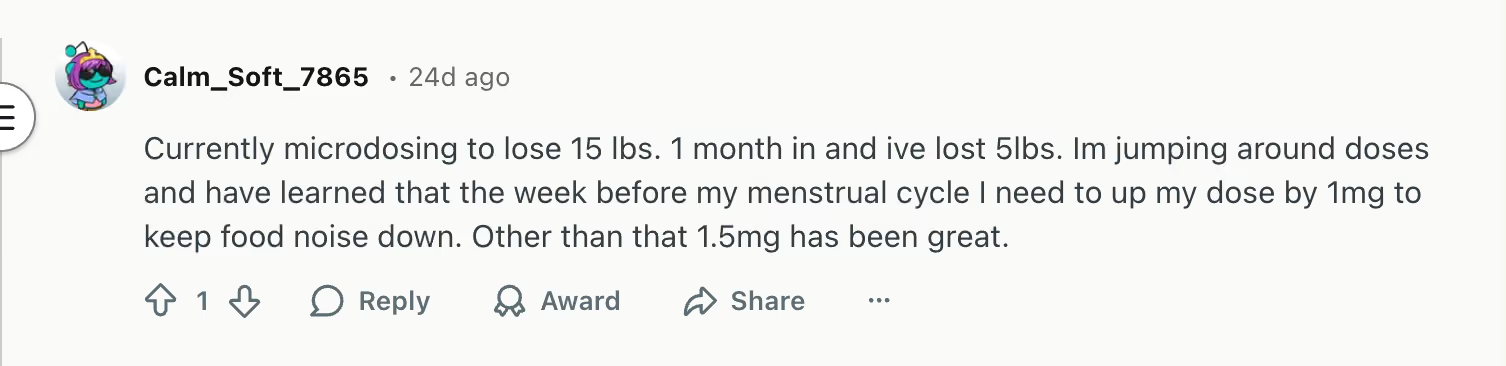
One user reports losing 5lbs within a month…
“Currently microdosing to lose 15 lbs. 1 month in and I've lost 5lbs. I'm jumping around doses and have learned that the week before my menstrual cycle, I need to up my dose by 1mg to keep food noise down. Other than that, 1.5mg has been great.”
Negative :
A week later, she reports:
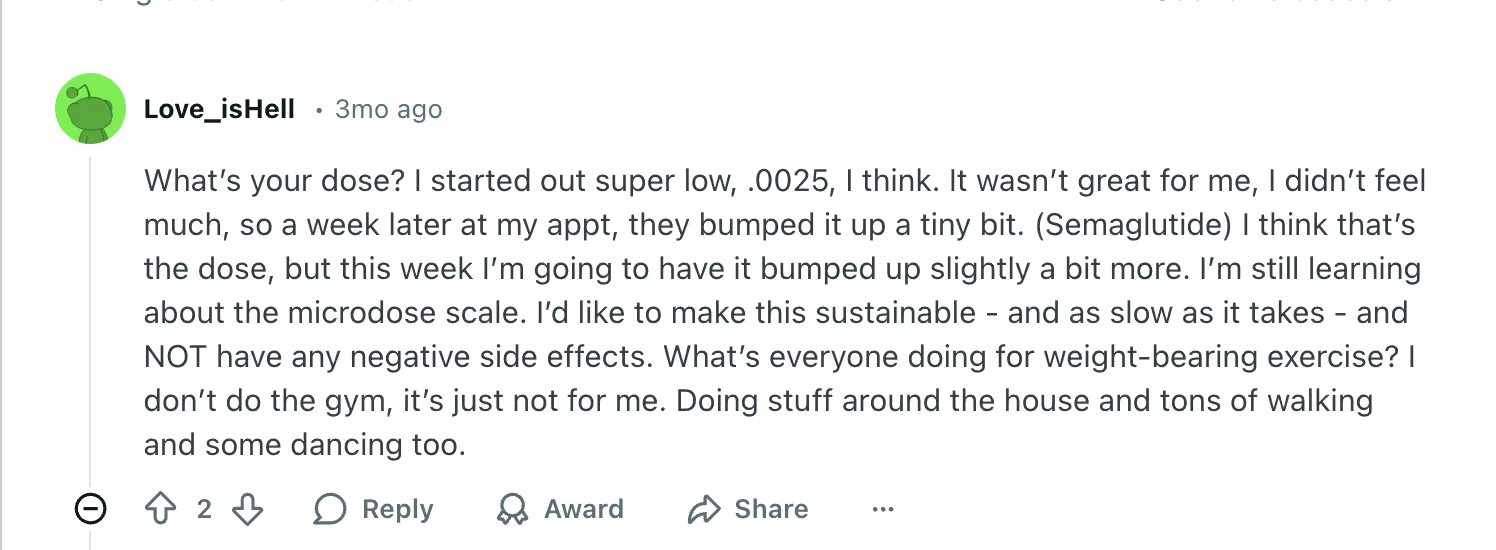
“What’s your dose? I started out super low, .0025, I think. It wasn’t great for me, I didn’t feel much, so a week later at my appt, they bumped it up a tiny bit. (Semaglutide) I think that’s the dose, but this week I’m going to have it bumped up slightly a bit more. I’m still learning about the microdose scale. I’d like to make this sustainable - and as slow as it takes - and NOT have any negative side effects.”
What Research Models and Early Data Suggest
Most microdosing claims draw from user reviews, rather than direct clinical evidence.
But STEP trial data on GLP-1 therapies suggests low doses may yield inconsistent results.
When dosing remains well below the levels studied, blood concentrations may be too low to meaningfully suppress appetite or reduce body weight in many people.
Low dose maintenance may be supported. However, in STEP 4, participants who continued semaglutide maintained more weight loss than those who stopped.
However, the study did not establish a specific low-dose or microdose target for long-term maintenance.
Take the Next Step With Professional Guidance From Ivy Rx
Microdosing semaglutide without supervision is a gamble. Doing it with a licensed provider who personalizes your dose? That's a strategy.
Ivy Rx's microdose GLP-1 injections pair you with a licensed physician who determines the right dose for your situation.
Everything happens online with no insurance required, medication delivered to your door, starting at $155 per month.
Not sure if microdosing is right? Ivy Rx also offers standard personalized GLP-1 injections from $175 per month.

%25201.avif)

Ivy RX patients
Members of Ivy RX branded medications were paid for their testimonials.
- John P.H. Wilding, D.M., Rachel L. Batterham, M.B., B.S., Ph.D., Salvatore Calanna, Ph.D., Melanie Davies, M.D., Luc F. Van Gaal, M.D., Ph.D., Ildiko Lingvay, M.D., M.P.H., M.S.C.S. https://orcid.org/0000-0001-7006-7401, Barbara M. McGowan, M.D., Ph.D., +7 , for the STEP 1 Study Group: https://www.nejm.org/doi/full/10.1056/NEJMoa2032183.
- Cengiz A, Wu CC, Lawley SD. Alternative dosing regimens of GLP-1 receptor agonists may reduce costs and maintain weight loss efficacy. Diabetes Obes Metab. 2025 Apr;27(4):2251-2258. https://pmc.ncbi.nlm.nih.gov/articles/PMC11885104/. doi: 10.1111/dom.16229.
- Garvey WT, Batterham RL, Bhatta M, Buscemi S, Christensen LN, Frias JP, Jódar E, Kandler K, Rigas G, Wadden TA, Wharton S; STEP 5 Study Group. Two-year effects of semaglutide in adults with overweight or obesity: the STEP 5 trial. Nat Med. 2022 Oct;28(10):2083-2091. https://pubmed.ncbi.nlm.nih.gov/36216945/. DOI: 10.1038/s41591-022-02026-4.
- Catalfamo L, De Ponte FS, De Rinaldis D. "Ozempic Face": An Emerging Drug-Related Aesthetic Concern and Its Treatment with Endotissutal Bipolar Radiofrequency (RF)-Our Experience. J Clin Med. 2025 Jul 25;14(15):5269. https://pmc.ncbi.nlm.nih.gov/articles/PMC12346945/. doi: 10.3390/jcm14155269.
- Rubino D, Abrahamsson N, Davies M, Hesse D, Greenway FL, Jensen C, Lingvay I, Mosenzon O, Rosenstock J, Rubio MA, Rudofsky G, Tadayon S, Wadden TA, Dicker D; STEP 4 Investigators. Effect of Continued Weekly Subcutaneous Semaglutide vs Placebo on Weight Loss Maintenance in Adults With Overweight or Obesity: The STEP 4 Randomized Clinical Trial. JAMA. 2021 Apr 13;325(14):1414-1425. https://pubmed.ncbi.nlm.nih.gov/33755728/. DOI: 10.1001/jama.2021.3224.
Related
Resources

What Does Semaglutide Do To Your Body?
Semaglutide is a drug similar to the endogenous GLP-1 peptide secreted from the intestinal L-cells. GLP-1 is released from the intestine and exh...

Complete Guide to Semaglutide Dosage For Weight Loss: Dosage Schedule & Adjustments (+Chart)
Ensure proper semaglutide usage with our dosage chart, adjustment tips, and helpful advice on what to do when you miss a dose.

Microdosing Retatrutide 101: How it Works, Benefits & Risks
Microdosing retatrutide explained: understand its benefits, possible side effects, and how telehealth platforms like IvyRx support safe access.