





.avif)


Article Outline
Start your personalized GLP-1 program


Does Blue Cross Blue Shield Cover Ozempic + 5 Alternative Options in 2026
Your doctor prescribed the therapy. You’re taking the medication as directed, managing side effects, and making the lifestyle changes that come with treatment.
Yet you’re left wondering whether Blue Cross Blue Shield (BCBS) will continue to cover your treatment, or if the cost will fall on you.
The question here isn’t just about eligibility but also about stability. Because coverage can change by plan, employer, or renewal year, and GLP-1 medications for weight loss are often the first to be cut.
And that uncertainty makes it hard to plan, budget, or stay consistent with treatment.
This guide explains how Blue Cross Blue Shield coverage for Ozempic works in 2026, what typically determines approval, what you may pay with or without insurance, and what options exist if coverage is denied.
Does Blue Cross Cover Ozempic?
Blue Cross Blue Shield coverage for Ozempic depends on multiple factors.
BCBS may cover Ozempic when it’s prescribed for Type 2 diabetes, but coverage varies by plan, prior authorization requirements, and specific benefit design.
Oftentimes, your coverage determination comes down to four critical factors:
Factor #1: Your Diagnosis
BCBS plans typically require a diabetes diagnosis, often supported by HbA1c results that show ongoing blood sugar management needs.
Factor #2: Your Specific BCBS Plan
Each Blue Cross Blue Shield company manages its own formulary and tier placement, so Ozempic copays and coverage vary by plan and state.
Some plans place it in higher cost tiers, resulting in higher out-of-pocket costs.
Factor #3: Prior Authorization Requirements
Most Blue Cross Blue Shield plans require prior authorization for Ozempic.
Approval typically depends on a confirmed Type 2 diabetes diagnosis and documentation showing that other standard diabetes treatments, like metformin, were ineffective or not tolerated.
Factor #4: Coverage Changes
Many BCBS plans announced that weight-loss GLP-1 medications would no longer be covered under standard pharmacy benefits as plans renew in 2026.
These decisions followed rising pharmacy costs across multiple BCBS organizations.
For example, Blue Cross Blue Shield of Massachusetts reported that GLP-1 medications accounted for nearly 20% of its pharmacy spending in 2024 — over $300 million, roughly double the prior year.
How Much Does Ozempic Cost With and Without Insurance?
Ozempic's pricing varies dramatically depending on your insurance coverage and the pharmacy you use.
Without Insurance:
- Average retail price: $1,396 per 30-day supply before any manufacturer discounts or pharmacy coupons
With BCBS Insurance: Your costs depend on where your plan places Ozempic in its drug tier system:
- Tier 2 (Preferred Brand): $30-$75 copay per month
- Tier 3 (Non-Preferred Brand): $66-$125 copay per month (most common)
- Tier 5-6 (Specialty Tiers): $150-$300+ copay or 25-33% coinsurance
When Ozempic is covered by insurance, out-of-pocket costs vary widely depending on plan design, copay tiers, and deductibles, with some members paying low copays and others paying higher ones.
With Manufacturer Savings: Novo Nordisk offers the NovoCare Savings Card, which reduces copays to as little as $25 per month for up to 24 months, with a maximum savings of $150 per prescription.
However, this program requires commercial insurance and doesn't work with Medicare, Medicaid, or cash-pay patients.
To explore more affordable alternatives, see our guide on cheaper alternatives to Ozempic.
How Do You Check If Your Blue Cross Plan Covers Ozempic?
Verify your specific coverage using these three methods:
1. Review Your Plan's Formulary
- Log in to your BCBS member portal.
- Open Prescription Benefits or Pharmacy Benefits.
- Search for Ozempic in the drug list.
- Check the drug tier and whether prior authorization (PA) is required.
- Confirm the formulary’s effective date, since formularies can change during the year.
2. Call BCBS Customer Service Directly
- Use the phone number on the back of your member ID card.
- Have your member ID and group number ready.
- Ask specifically about Ozempic coverage, tier placement, and prior authorization requirements.
- Request information about your plan's specific coverage for diabetes medications.
3. Use Novo Nordisk's Coverage Tool
- Visit NovoCare's insurance verification service.
- Call 1-844-Novo4Me (1-844-668-6463) or fill out their online form.
- An agent researches your specific plan and provides detailed coverage information.
Alternative Access Options If Ozempic Isn't Covered by Blue Cross
If BCBS denies your Ozempic coverage or your copays exceed your budget, you have several alternatives that provide the same active ingredient or similar weight-loss benefits.
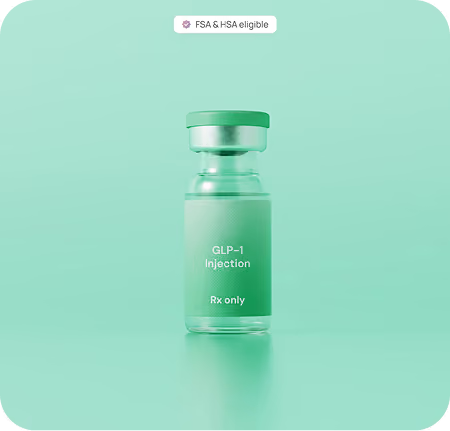
Option #1: Personalized GLP-1 Injections Through Telehealth
Personalized GLP-1 injections use the same active ingredient as Ozempic (semaglutide), and the cost starts at around $175 per month, compared with brand-name prices that can exceed $1,300 per month.
These injections are commonly provided through telehealth platforms like IvyRx.
You complete a medical evaluation, receive dosing guidance, and stay under ongoing provider supervision, without prior authorization or insurance requirements.
Best for: Patients denied insurance coverage, those facing high brand-name copays, or anyone without insurance who needs affordable access to semaglutide.
For a comprehensive comparison, read our guide on GLP-1 vs Ozempic.
Option #2: Other FDA-Approved GLP-1 Medications
Some GLP-1 medications may be easier to cover through insurance or cost less than Ozempic, depending on your plan.
- Mounjaro (tirzepatide): Mounjaro is often covered for Type 2 diabetes with prior authorization. Commonly placed in Tier 3 or 4. A manufacturer's savings card may lower copays for people with commercial insurance.
- Trulicity (dulaglutide): Prior authorization may be simpler than with Ozempic, and weight loss tends to be more modest.
- Rybelsus (oral semaglutide): A daily pill with the same active ingredient as Ozempic. Coverage rules are similar, with prior authorization usually required for diabetes. A good option if you want to avoid injections.
- Victoza (liraglutide): A daily injectable GLP-1 for diabetes. Generic liraglutide became available in 2024, which may improve coverage and reduce cost for some plans.
Compare these options in detail: Wegovy, Ozempic, and Mounjaro.
Option #3: Non-GLP-1 Weight Loss and Diabetes Medications
- Metformin: Metformin is the first-line pharmacologic treatment for type 2 diabetes globally and in the U.S. The cost ranges from $4 to $30 per month for generic versions. It is usually covered by BCBS as a Tier 1 medication. While primarily for diabetes, it provides modest weight loss benefits and improves insulin sensitivity.
- Contrave (Naltrexone-Bupropion): Contrave is an FDA-approved, prescription-only, chronic weight-loss medication, costing $400–$960 per month.
- Manufacturer Assistance Programs: Novo Nordisk’s Patient Assistance Program provides free Ozempic to eligible patients whose household income is at or below 400% of the Federal Poverty Level, subject to additional eligibility requirements.
For additional options, explore alternatives to Ozempic and the cheapest semaglutide options without insurance.
Option #4: Appealing Insurance Denials
If BCBS denies your Ozempic prior authorization, don't give up. Internal appeals succeed 39-59% of the time, according to research from the U.S. Government Accountability Office.
How to appeal:
- Request detailed denial reasons from BCBS.
- Gather additional medical documentation (HbA1c labs, treatment history, physician notes).
- Have your doctor write a letter of medical necessity explaining why Ozempic is essential to your health.
- Include peer-reviewed studies supporting the use of semaglutide for your condition.
- Submit within 180 days of the denial.
If internal appeals fail, most states guarantee external review through Independent Review Organizations.
Interested in getting Wegovy? You can learn more about Wegovy Requirements for Insurance Coverage.
Option #5: Pharmacy Shopping and Discount Programs
Cash prices vary significantly between pharmacies. Compare prices at:
- CVS
- Walgreens
- Costco (often lowest pricing, membership required)
- Independent local pharmacies
- Mail-order pharmacies (90-day supplies typically offer better per-month pricing)
Discount cards like SingleCare, GoodRx, and RxSaver may reduce Ozempic's cash price by 10-30%.
These only work for self-pay patients; you can't combine them with insurance.
To understand Medicaid coverage options, read Does Medicaid Cover Ozempic.
Access Affordable GLP-1 Weight Loss Solutions Without Insurance at IvyRx
Insurance denials and high copays shouldn't prevent you from accessing effective weight-loss treatment.
IvyRx offers personalized GLP-1 injections with the same active ingredient as Ozempic, at a fraction of the cost.
Starting at $175 per month, you receive:
- Direct-to-door delivery.
- Ongoing support and dosing adjustments.
- Subcutaneous injections (self-administered at home).
- Complete physician evaluation and medical clearance.
- Personalized dosing based on your response and goals.
No prior authorization. No insurance headaches. Just straightforward access to physician-supervised GLP-1 therapy.
FAQ
Can You Apply for Ozempic Coverage With Blue Cross?
Yes, but approval is not automatic.
Most BCBS plans require prior authorization. This means your doctor must show that Ozempic is medically necessary. That includes a confirmed Type 2 diabetes diagnosis, recent HbA1c lab results, and proof that other diabetes medications did not work well enough.
How Can I Get Ozempic for Free?
Novo Nordisk's Patient Assistance Program provides free Ozempic to uninsured or underinsured patients with household income at or below 400% of the Federal Poverty Level.
You can apply through the Novo Nordisk website or by calling their patient support line.
Alternatively, get personalized GLP-1 injections priced at $175 per month from Ivy Rx. This is significantly more affordable than the $1,396 brand-name cash price.

%25201.avif)

Ivy RX patients
Members of Ivy RX branded medications were paid for their testimonials.
- https://www.bluecrossnc.com/content/dam/bcbsnc/pdf/members/medicare/forms-library/annual-notice-of-changes/anoc-enhanced-hmo-pos-024-001-to-002-26.pdf. Accessed 31st January, 2026.
- https://newsroom.bluecrossma.com/2025-02-28-BLUE-CROSS-BLUE-SHIELD-OF-MASSACHUSETTS-ANNOUNCES-LATEST-RESULTS. Accessed 31st January, 2026.
- https://www.fda.gov/news-events/press-announcements/fda-approves-first-generic-once-daily-glp-1-injection-lower-blood-sugar-patients-type-2-diabetes. Accessed 31st January, 2026.
- Flory J, Lipska K. Metformin in 2019. JAMA. 2019 May 21;321(19):1926-1927. https://pubmed.ncbi.nlm.nih.gov/31009043/. DOI: 10.1001/jama.2019.3805.
- Yerevanian A, Soukas AA. Metformin: Mechanisms in Human Obesity and Weight Loss. Curr Obes Rep. 2019 Jun;8(2):156-164. https://pmc.ncbi.nlm.nih.gov/articles/PMC6520185/. doi: 10.1007/s13679-019-00335-3.
- https://www.accessdata.fda.gov/drugsatfda_docs/label/2021/200063s020lbl.pdf. Accessed 31st January, 2026.
- https://moheartcenter.com/wp-content/uploads/2024/01/Ozempic-2023.pdf. Accessed 31st January, 2026.
- https://www.gao.gov/assets/gao-11-268-highlights.pdf. Accessed 31st January, 2026.
Related
Resources
%2520(5).png)
Is Ozempic (Semaglutide) Safe? Benefits & Risks in 2026
Want to know if Ozempic (Semaglutide) is safe for weight loss? Understand how semaglutide works, benefits & common side effects.

Wegovy Requirements For Insurance Coverage Explained (2026)
Learn how to get Wegovy covered by insurance, the cost breakdown, and the steps you can take to ensure you receive the medication through your health plan.
.png)
How To Get Ozempic Without Insurance: Costs & Options (2026)
Planning to get Ozempic without insurance? Learn about the costs, key considerations, and alternatives.