





.avif)


Article Outline
Start your personalized GLP-1 program


Microdosing GLP-1 Cost: Complete 2026 Pricing Guide
Standard GLP-1 treatments can become expensive quickly. Without insurance, monthly costs often rise beyond what many people can maintain long-term.
That’s why microdosing gets so much attention. It offers a lower monthly cost and a more gradual way to start treatment. But the real question isn’t just what microdosing costs upfront. It’s what it costs over time.
This guide walks through real pricing, the factors that influence microdosing costs, and how to choose an option that stays affordable without sacrificing medical oversight.
What Microdosing GLP-1 Typically Costs
The cost of GLP-1 microdosing differs slightly. Semaglutide microdosing usually ranges from $150–$300, while tirzepatide microdosing typically runs $250–$450.
Microdosing may lower early costs because you start with smaller dose volumes, which some people find easier to tolerate.
If you want a quick overview of why people choose this approach, read our guide on the benefits of microdosing GLP-1.
Although your total cost can still increase if a program adds consult fees, memberships, or more extended subscription periods.
These fees compound and may become too expensive to maintain, so it helps to review a typical GLP-1 microdosing schedule.
With Ivy Rx, you can start an affordable, personalized microdose GLP-1 plan with transparent pricing and no surprise charges.
For deeper pricing breakdowns, see our guide on Semaglutide compounding pharmacy cost and Tirzepatide average pricing.
Factors That Affect the Cost of Microdosing a GLP-1
Here are five key drivers that determine your monthly microdosing GLP-1 cost.
Driver #1: Starting Dose and Medication Volume
Microdosing begins with smaller doses, so you use less medication each week. That keeps early costs lower.
For example, a 0.125 mg semaglutide dose uses about half as much medication as the standard 0.25 mg starting dose. Over the first few months, that difference adds up.
Typical microdosing starting ranges:
- Semaglutide: 0.05–0.25 mg per week
- Tirzepatide: 1–2.5 mg per week
During the first 3–6 months, some people spend $50–$150 less per month than with standard dosing. As doses increase, monthly costs rise, and the gap usually narrows at maintenance.
Driver #2: Medication Type
Compounded semaglutide consistently costs $100- $150 less per month than compounded tirzepatide at comparable dose levels and treatment stages.
Why does semaglutide cost less?
- It works through a single GLP-1 pathway, simplifying dosing.
- More telehealth programs offer it, which creates price competition.
- Higher demand allows pharmacies to operate more efficiently at scale.
- It has been used longer, so production and sourcing are more established.
Why tirzepatide costs more:
- Dual-agonist complexity (GLP-1 + GIP) requires more advanced compounding techniques.
- Newer to the compounding market since 2022, with less established supply chains.
- Fewer providers currently offer it, reducing competitive pricing pressure.
- Higher raw material costs for dual-mechanism formulation ingredients.
Compare semaglutide vs tirzepatide weight loss outcomes before deciding which medication suits your needs.
Driver #3: Titration Speed and Treatment Duration
Standard titration typically reaches maintenance doses in 12-16 weeks. The typical GLP-1 microdosing schedule takes 20-32 weeks to get the same therapeutic level (some patients may stay on a microdose if they feel happy with their weight loss).
So, if you stay on medication for weight maintenance afterwards, slower titration may add 6-12 months of payments to your total treatment cost.
Cost comparison example:
- Standard protocol (12 months total): 12 months × $1,000 = $12,000.
- Microdosing (18 months): 18 months × $300 = $5,400 (saves $6,600).
- Microdosing (24 months extended): 24 months × $300 = $7,200 (saves $4,800).
Important note: Reviewing the common side effects of microdosing GLP-1 can help you identify when it is time to slow down or stay at your current dose. Faster titration, when tolerable, significantly reduces total cost over your full treatment course.
Faster titration, when tolerable, significantly reduces total cost over your full treatment course.
Driver #4: Provider Type and Program Fees
Telehealth providers and traditional clinics structure costs very differently, which directly affects your monthly out-of-pocket expenses.
Telehealth subscription models:
- Monthly medication + consultation: $200-$400 all-inclusive pricing.
- Medical oversight and secure messaging support are included in the monthly price.
- Some providers charge a separate $45- $145 monthly membership fee in addition to medication costs.
Traditional clinic structure:
- Medication dispensing: $300-$500/month.
- Total monthly cost: $450-$900/month, including all fees.
- Lab work and monitoring tests: $50-$200 per test ordered.
- In-person office visits: $100- $200 per visit (typically monthly or biweekly).
In general, telehealth typically saves $200- $500 per month compared to traditional in-person care.
Microdosing Costs for Different GLP-1 Types
Each GLP-1 medication has a different pricing structure.
Semaglutide Microdosing
Monthly cost: $150-$300 (telehealth), $300-$500 (traditional clinics)
Semaglutide remains the most affordable microdosing option among all GLP-1 medications. A longer compounding history and a simpler single-hormone mechanism keep production costs lower than those of newer dual-agonist alternatives.
Cost trajectory over treatment:
- Months 1-3 (0.05-0.125 mg): $150-$200/month
- Months 4-6 (0.25-0.5 mg): $200-$250/month
- Months 7+ (1-2 mg maintenance): $250-$300/month
Best for budget-conscious patients and first-time GLP-1 users seeking an affordable entry. Check the Semaglutide dosage guide for complete titration schedules.
Tirzepatide Microdosing
Monthly cost: $250-$450 (telehealth), $400-$600 (clinics)
Tirzepatide costs $100-$150 more monthly than semaglutide. This premium reflects the dual-agonist mechanism, which requires more complex compounding.
Cost trajectory:
- Months 1-3 (1-2.5 mg): $250-$350/month.
- Months 4-6 (2.5-5 mg): $300-$400/month.
- Months 7+ (5-10 mg maintenance): $400-$450/month.
Initial doses at $250- $350/month versus standard Zepbound at $1,000+/month result in $650- $750 monthly savings.
Learn about Retatrutide vs Tirzepatide for emerging options.
Retatrutide (Future Option)
Projected cost: likely $400-$700/month when available
Triple-agonist retatrutide awaits FDA approval expected in 2026-2027. Early launch pricing will reach $600-$700/month, though many are already exploring Retatrutide microdosing as a way to manage its potent triple-hormone effects more affordably.
Microdosing vs Standard Dosing: Cost Comparison
Where Microdosing Saves Money
- Early treatment phases: Lowering medication volume in months 1-6 saves $600-$900 per month.
- Reduced side effects: Fewer GI issues eliminate the need for anti-nausea medication ($20-$50/month). Gentler titration prevents early discontinuation.
- Flexible dosing: Some providers allow bi-weekly dosing at lower monthly costs. Example: 0.125 mg every 2 weeks costs $75- $150 per month.
Where Microdosing May Cost More
- Extended duration: If microdosing extends treatment from 12 to 18-24 months, you pay more total despite lower monthly costs. The savings gap narrows significantly.
- Insurance advantage: Compounded microdosing isn’t covered by insurance. If you have insurance that covers standard GLP-1s with $25-$100 copays, the insurance option may be financially advantageous for patients.
$50 copay × 12 months = $600 total beats $300 microdosing × 12 = $3,600 total in this case. - Extra monitoring: Some patients need additional labs or consultations to fine-tune lower doses. This adds $50-$200 per visit.
Always verify insurance coverage first and seek medical advice.
Read our comparison guide on Wegovy, Ozempic and Mounjaro comparison, semaglutide vs Mounjaro and liraglutide vs semaglutide for other options.
How to Reduce the Cost of Microdosing GLP-1
Here are six strategies that may reduce your GLP-1 microdosing compounding cost by $1,500- $3,000 over the course of treatment.
Step #1: Start With Semaglutide Before Trying Tirzepatide
Semaglutide costs $100-$150 less monthly than tirzepatide. Begin with semaglutide to establish tolerance and assess response. Many patients achieve goals without needing the more expensive dual agonist. Always take advice from your medical professional first.
Savings: $1,200-$1,800 over 12 months
Switch to tirzepatide only if weight loss plateaus after 3-4 months on semaglutide.
Step #2: Use Multi-Dose Vials Over Single-Dose Pens
Compounded GLP-1s come in multi-dose vials. You draw your dose with a syringe, allowing precise microdosing and reducing waste.
- Multi-dose vials: $200-$350/month
- Single-dose pens: $400-$600/month
Savings: $150-$250 monthly
Multi-dose vials require basic injection skills. Your provider supplies syringes and teaches proper subcutaneous injection technique. Most patients feel comfortable after 1-2 practice sessions.
Step #3: Accelerate Titration When Tolerable
Slower titration extends treatment duration and total cost.
Timeline comparison:
- Standard microdosing: 20-32 weeks to maintenance
- Accelerated: 12-20 weeks to maintenance
Savings example:
- Slow (24 months): $7,200 total
- Moderate (16 months): $4,800 total
- Saves: $2,400
Don't rush past tolerable side effects.
You can track how long semaglutide suppresses appetite and how long you stay on semaglutide to optimize timing.
Step #4: Compare Total Program Costs
Calculate the medication, consultations, and supplies before making a decision.
Example:
Provider A: $179 medication + $45 consult = $224 total. Provider B: $249 all-inclusive with unlimited consults.
Provider B costs $25 more per month, but may save you money if you need frequent contact with the provider.
Step #5: Use First-Month Discounts
Many telehealth providers offer promotional pricing to reduce the cost of microdosing GLP-1:
- Noom: $99 first month (then $199)
- MEDVi: $179 first month flat (you can read our full MEDVi review to see if their pricing and platform fit your goals)
- Henry Meds: $100 off first month
Savings: $50-$100 in month 1.
These promotions let you test tolerance before committing.
For more budget options, learn how to get the cheapest Semaglutide without insurance, and see more details on the Wegovy cost without insurance.
Step #6: Choose a Program With Flat Pricing and Built-In Care
One of the easiest ways to control microdosing costs is to avoid programs that stack fees as you go.
Some telehealth options charge separately for:
- Medication.
- Provider visits.
- Dose increases.
- Follow-up questions.
These fees add up fast. Ivy Rx takes a different approach.
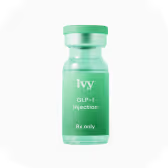
The Ivy Rx microdose GLP-1 program offers a fixed monthly price of $155 for four doses, with no price changes as your dose adjusts. That cost includes:
- Medical evaluation and ongoing provider access.
- Personalized microdose guidance.
- Medication delivery to your door.
Learn more about Ivy Rx’s microdose GLP-1 injections and how the program works.
Who Microdosing Is Most Cost-Effective For
Cost-Effective Scenarios
- No insurance coverage: Microdosing at $200- $400/month beats brand-name medications at $1,000- $1,300/month.
- Tight budgets: Lower monthly payments ($200-$300 vs $1,000+) make treatment accessible despite similar 18-24 month total costs.
- Super-responders: Patients achieving results at 0.25-0.5 mg pay less monthly indefinitely for maintenance.
- Maintenance phase: Low-dose maintenance costs $150-$200/month, compared with $300-$400 for standard.
- Side-effect sensitivity: Gentler titration helps prevent discontinuation. Staying on tolerable medication beats paying for treatment you quit.
NOT Cost-Effective For
- Insurance-covered patients: Don't pay $300/month cash when insurance covers standard GLP-1s at $25-$100 copays.
- Rapid loss needs: Microdosing delays therapeutic doses. Standard dosing suits medical urgency despite higher monthly costs.
- High BMI: If you ultimately need 2 mg semaglutide or 10 mg tirzepatide, microdosing adds 6-12 months of sub-therapeutic costs.
- Complex medical cases: Frequent monitoring needs suit traditional clinics ($450-$700/month) better than telehealth, despite higher costs.
Use Ivy Rx's BMI calculator and TDEE calculator to determine your eligibility and whether microdosing fits your needs.
Get Personalized, Affordable Microdose GLP-1 Access With Ivy RX
Ivy Rx offers transparent pricing starting at $155 for 4 x doses per month for personalized microdose GLP-1 injections.
This includes medical evaluation, ongoing provider access, and quality pharmacy partnerships, with no hidden fees.

%25201.avif)

Ivy RX patients
Members of Ivy RX branded medications were paid for their testimonials.
Related
Resources

13 Benefits of Microdosing GLP-1 (Is it Really Better?)
Curious about microdosing GLP-1? Learn what it is, potential benefits, how it works, and if smaller, personalized doses can improve results and reduce side effects.

Does Microdosing GLP-1 Work? What the Evidence Shows (2026)
Does microdosing GLP-1 actually work for weight loss or appetite control? Learn what patients experience, what evidence exists, and key limitations.
%2520(1).avif)
Microdosing GLP-1 Reviews: Real User Results, Experiences, Side Effects & Costs
Curious whether GLP-1 microdosing works? See real user reviews on results, appetite changes, side effects, and costs—plus who benefits most from microdosed semaglutide and tirzepatide.