





.avif)


Article Outline
Start your personalized GLP-1 program


Ozempic Shortage & What Patients Can Do Now (2026 Update)
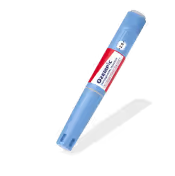
If you have been told your pharmacy is out of Ozempic®, it is easy to assume the shortage is back. But the 2026 Ozempic® shortage picture is more specific than that.
The national FDA shortage ended in 2025. What patients may still run into now is a local stockout, a dose-level delay, or a pharmacy supply-chain issue.
This guide explains the current Ozempic® availability update, what caused the shortage, what happened to compounded semaglutide after the shortage ended, and what to do if your pharmacy cannot fill your prescription.
Is the Ozempic® Shortage Over?
Yes. The national Ozempic® shortage is over.
FDA determined on February 21, 2025, that the shortage of semaglutide injection products had been resolved. Semaglutide injection products include Ozempic® and Wegovy®, both made by Novo Nordisk. FDA later stated that semaglutide injection products do not currently appear on its drug shortage list.
That does not mean every patient will find every dose at every local pharmacy all the time. FDA has also noted that patients and prescribers may still see intermittent, limited, localized supply disruptions as products move from the manufacturer to distributors and local pharmacies.
So if one pharmacy says Ozempic® is out of stock, it does not automatically mean there is a new national shortage. It usually means you need to check your exact dose, nearby pharmacies, wholesaler timing, and next refill window.
For additional context, read more about the semaglutide shortage, whether Ozempic® is semaglutide, and Ozempic® dosing.
What Caused the Ozempic® Shortage?
The Ozempic® shortage was caused mainly by demand growing faster than supply could keep up. GLP-1 medications became more widely used for type 2 diabetes, weight management, and related metabolic-health goals, while manufacturing capacity took time to expand.
Here is the simple timeline:
Novo Nordisk also expanded manufacturing capacity during and after the shortage period. In February 2025, Novo Nordisk said FDA’s assessment confirmed that U.S. supply of Ozempic® and Wegovy® met or exceeded current and projected U.S. demand. The company also pointed to major U.S. manufacturing investments to expand supply.
The important takeaway is that a shortage can end at the national level before every local pharmacy experience feels perfect. Pharmacies depend on wholesaler supply, dose availability, timing, prescription volume, and local demand.
For more on why demand rose so quickly, read about celebrities on Ozempic®, GLP-1 receptor agonists, and what Ozempic® does to your brain.
What Happened to Compounded Semaglutide After the Shortage?
The end of the national shortage changed the rules around many compounded semaglutide copies.
During a drug shortage, compounding pharmacies and outsourcing facilities may have more room to compound certain medications under specific federal rules. Once FDA determined the semaglutide injection shortage was resolved, FDA also set phaseout periods for shortage-related compounding of semaglutide injection products that were essentially copies of approved drugs.
In plain English: the shortage ending did not make every form of compounding disappear overnight, but it did remove the shortage-based reason many compounded semaglutide copies were being made.
FDA’s enforcement-discretion timeline for semaglutide injection compounding ended in 2025. For state-licensed pharmacies and physicians under section 503A, the period ended after the April 24, 2025 district court decision. For 503B outsourcing facilities, FDA’s stated phaseout period ran until May 22, 2025.
For patients, that means three things:
FDA has also warned patients about unapproved GLP-1 drugs used for weight loss, including concerns around dosing errors, product quality, and misleading comparisons to FDA-approved medications. Use official sources, your clinician, and a legitimate pharmacy pathway rather than relying directly on social-media recommendations or “research use” products.
For more background, read our guides on whether compounded semaglutide is safe, whether compounded semaglutide is the same as Ozempic®, and compounded semaglutide reviews.
What to Do if Your Pharmacy Is Out of Ozempic®
If your pharmacy is out of Ozempic®, start with practical supply checks before changing your treatment plan. Do not change your dose, skip doses repeatedly, or switch medications without your prescribing clinician’s guidance.
Step 1: Ask Whether Your Exact Dose Is Out
Ask the pharmacy whether your exact Ozempic® strength is unavailable, or whether all Ozempic® doses are unavailable at that location.
This matters because stock can vary by dose. Your pharmacy may be out of your current pen but able to order it within a few days. Another nearby branch may have the same dose in stock.
Ask these questions:
- Is my exact Ozempic® dose out of stock?
- Is it unavailable at this pharmacy only, or across your local network?
- Can you see whether another branch has it?
- Can you order it from the wholesaler?
- When is the next expected shipment?
- Can you notify me when it arrives?
Try to check at least 5 to 7 days before your refill is due. That gives you more time to solve the problem before your next scheduled dose.
For prescription-access basics, read how to get an Ozempic® prescription.
Step 2: Call Nearby Pharmacies Before Switching Anything
If your regular pharmacy cannot fill Ozempic®, call other pharmacies before assuming you need a different medication.
Check a mix of options:
- Other branches of the same chain
- Independent pharmacies
- Grocery-store pharmacies
- Hospital outpatient pharmacies, if available
- Mail-order pharmacy options through your insurance plan
- Your insurer’s preferred pharmacy network
When you call, give the exact medication name, dose, and pen strength. Ask whether they can fill a transferred prescription and whether they accept your insurance or savings card.
Do not ask vaguely, “Do you have Ozempic®?” Ask for the exact dose your clinician prescribed. That makes the answer more useful.
If another pharmacy has it, ask your current pharmacy or clinician how to transfer the prescription correctly.
Step 3: Check Your Insurance and Savings Requirements
A pharmacy stock problem can turn into a cost problem quickly. Before transferring the prescription, confirm whether the new pharmacy works with your insurance, prior authorization, savings card, or discount route.
Brand-name Ozempic® can be expensive without coverage. Even when supply is available, patients may face deductibles, plan restrictions, refill limits, or prior authorization rules.
Before you move the prescription, ask:
- Will this pharmacy accept my insurance?
- Does my prior authorization still apply here?
- Can I use my manufacturer savings card?
- Will the price change if I transfer pharmacies?
- Is mail order cheaper or more reliable?
- Is there a refill-too-soon restriction?
If coverage is the bigger barrier, not stock, it may be time to compare other GLP-1 access routes.
For more help, read online semaglutide, semaglutide online programs, and how to get semaglutide.
Step 4: Contact Your Prescribing Clinician Before Missing Doses
If you cannot find Ozempic® before your next dose, contact your prescribing clinician. Do this before you miss multiple doses or try to adjust the dose on your own.
Your clinician may discuss options such as waiting a short period, restarting guidance if you miss doses, using a different pharmacy, reviewing another GLP-1, or changing the treatment plan. The right answer depends on why you take Ozempic®, your current dose, side effects, blood sugar history, and how long the delay may last.
This is especially important if you take Ozempic® for type 2 diabetes. Missing doses can affect blood sugar control, and your clinician may need to adjust monitoring or other medications.
Do not combine leftover pens, stretch doses, increase a lower dose, or use someone else’s medication. Those shortcuts can create dosing errors and safety problems.
Step 5: Discuss Alternatives if Stockouts Keep Interrupting Treatment
If stockouts keep happening, use that pattern as a reason to review your full treatment plan.
Ask your clinician:
- Is Ozempic® still the best fit for my diagnosis and goals?
- Are other GLP-1 options appropriate?
- Would Wegovy®, Mounjaro®, Zepbound®, Saxenda®, Victoza®, or another route make sense?
- Is there a more affordable option if cost is part of the issue?
- What should I do if I miss one dose versus several weeks?
- How should I restart if there is a long gap?
For weight-management goals, some patients compare FDA-approved brand-name medications, cash-pay telehealth programs, or compounded GLP-1 treatment pathways. The safest comparison is not only availability. It is clinician review, pharmacy standards, dosing guidance, side-effect support, and total monthly cost.
For more online access context, read ways to get semaglutide online for weight loss.
Ozempic® Alternatives Worth Considering
If Ozempic® is hard to find or too expensive, do not switch on your own. The safer move is to compare options with your prescribing clinician so your dose, diagnosis, side effects, blood sugar, and goals are all considered.
Here are common alternatives patients ask about:
Alternative 1: Wegovy®
Wegovy® contains semaglutide, the same active ingredient as Ozempic®, but it is approved for chronic weight management in eligible patients. That makes it a more direct brand-name option for people using semaglutide for weight-loss goals.
The trade-off is access and cost. Insurance coverage varies, and self-pay pricing depends on dose, program eligibility, and current NovoCare® terms.
If you are comparing the two, read GLP-1 vs Ozempic® and Ozempic® alternatives.
Alternative 2: Zepbound® or Mounjaro®
Zepbound® and Mounjaro® contain tirzepatide, not semaglutide. Tirzepatide activates both GIP and GLP-1 pathways, while semaglutide is a GLP-1 receptor agonist.
Zepbound® is approved for chronic weight management in eligible patients, while Mounjaro® is approved for type 2 diabetes-related use. These can be worth discussing if Ozempic® is unavailable, not covered, or not the best fit.
Do not treat tirzepatide and semaglutide as interchangeable. Your clinician should review your diagnosis, current dose, side effects, blood sugar history, and treatment goal before switching.
For a deeper comparison, check out Mounjaro® vs Ozempic®.
Alternative 3: Metformin or Other Non-GLP-1 Options
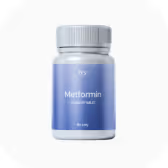
Metformin is not a direct Ozempic® replacement. It works differently and usually produces more modest weight changes. But for some patients with type 2 diabetes, insulin resistance, or cost concerns, it may be part of the conversation.
A clinician can help decide whether a lower-cost oral option fits your health history and goals, or whether you need stronger appetite support from a GLP-1 pathway.
For more context, check out metformin vs Ozempic® and cheaper Ozempic® alternatives.
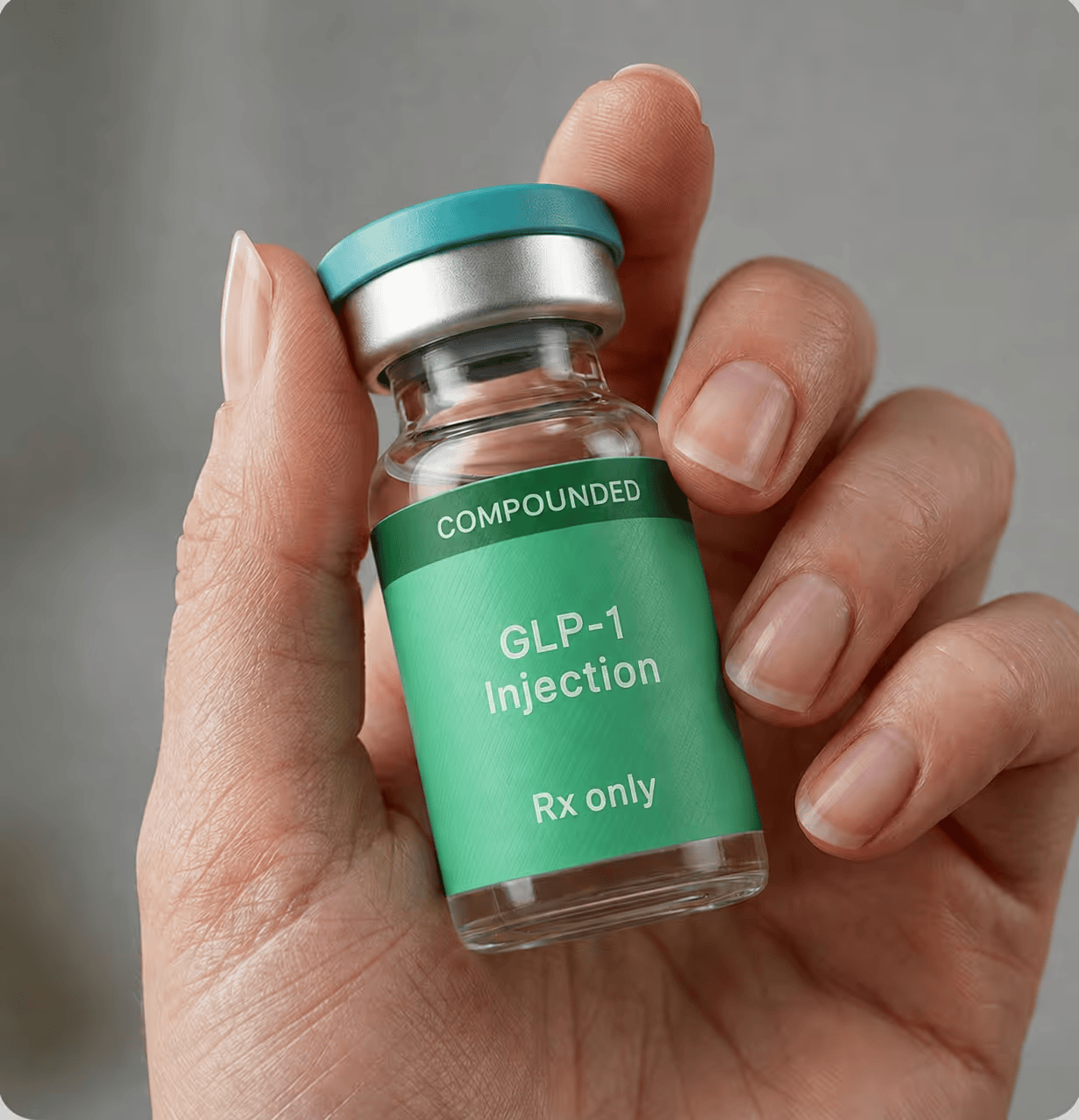
Alternative 4: Ivy Rx Compounded GLP-1 Injections
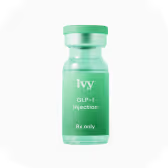
Ivy Rx’s Compounded GLP-1 Injections, which are made in the USA, may fit patients who want a no-insurance GLP-1 pathway with transparent pricing and licensed clinician review and pharmacy dispensing.
The value is the care pathway: clear pricing with a Rate Lock guarantee (so the cost stays consistent over dose titrations), dosing guidance, secure temperature-controlled shipping, and support after treatment starts.
If injections make you nervous, GLP-1 injections are subcutaneous, meaning they go into fatty tissue under the skin, not muscle. This self-administration tutorial video can help you understand the process before starting.
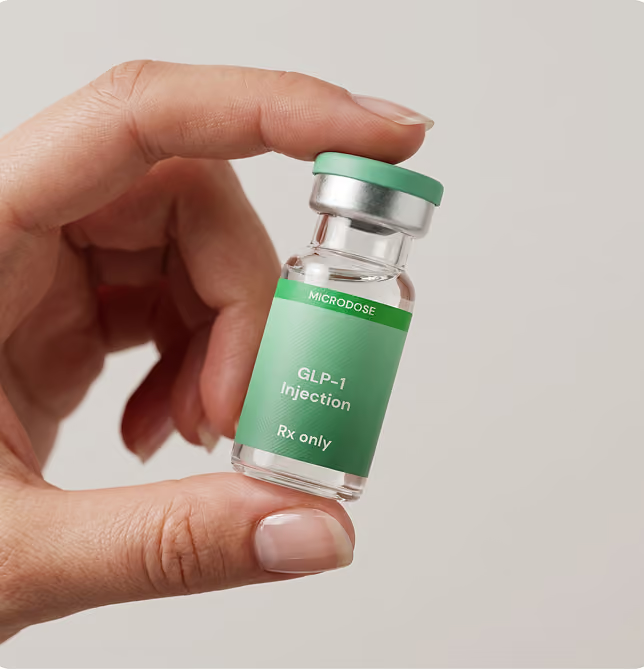
Alternative 5: Microdose GLP-1 Injections
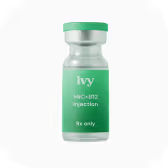
A microdose option may make sense for some patients who want a lower-dose GLP-1 entry point, are sensitive to side effects, or want a more gradual treatment path.
Ivy Rx’s Microdose GLP-1 Injections offer a lower-dose GLP-1 pathway for eligible patients, with online clinician review, no insurance needed, licensed pharmacy dispensing, and follow-up support.
This is not the same as brand-name Ozempic®. It is a different care pathway and should be considered accordingly.
How to Afford Ozempic® Now That Supply Is Back
Now that the national Ozempic® shortage is over, cost is often the bigger barrier.
Brand-name Ozempic® can still be expensive without insurance. NovoCare® currently lists a self-pay offer where eligible new patients may pay $199/month for each of the first two monthly fills of 0.25 mg and 0.5 mg Ozempic® pens through December 31, 2026. After that, NovoCare® lists $349/month for 0.25 mg, 0.5 mg, or 1 mg pens and $499/month for 2 mg pens, subject to eligibility and program terms.
Commercially insured patients may pay less if Ozempic® is covered and they qualify for savings. But coverage depends on diagnosis, plan rules, prior authorization, deductibles, and whether the prescription is for an FDA-approved use.
If price is the main problem, try these steps:
- Ask your insurer whether Ozempic® is covered for your diagnosis.
- Confirm whether prior authorization is required.
- Check whether your pharmacy can apply a manufacturer savings offer.
- Compare retail, mail-order, and preferred pharmacy pricing.
- Ask your clinician whether another covered GLP-1 is appropriate.
- Compare cash-pay telehealth options if insurance is not helping.
Ivy Rx currently offers brand-name Ozempic® where appropriate, as well as compounded GLP-1 Injections for eligible patients who want a no-insurance GLP-1 pathway with transparent pricing and licensed clinician review.
For more cost guidance, read how to get Ozempic® without insurance, cheapest semaglutide without insurance, and semaglutide without insurance.
Could Another Ozempic® Shortage Happen?
Another Ozempic® shortage is possible, but there is no reason to assume one is happening just because one pharmacy is temporarily out.
FDA continues to monitor drug shortages, and FDA has said semaglutide injection products do not currently appear on its drug shortage list. Novo Nordisk has also expanded manufacturing capacity, and FDA confirmed in 2025 that manufacturer supply and capacity could meet current and projected national demand.
Still, GLP-1 demand remains high. Local stockouts can happen because of wholesaler timing, dose-level demand, pharmacy ordering patterns, insurance refill windows, and regional supply flow.
Also ask your pharmacy whether they can order your next fill in advance, send a stock notification, or check nearby branches. If delays persist, talk with your clinician about whether alternative GLP-1 medications are more reliable for your situation.
For switching-related questions, read switching between GLP-1 agonists, switching from Ozempic® to Mounjaro®, Saxenda® vs Ozempic®, and Victoza® vs Ozempic®.
Keep Your Treatment on Track With Ivy Rx
A national shortage is no longer the main issue for Ozempic® in 2026. But you can still run into local stockouts, high prices, insurance barriers, and confusing alternatives.
Ivy Rx gives eligible patients a clear way to compare GLP-1 options online, including brand-name Ozempic®, Compounded GLP-1 Injections, and Microdose GLP-1 Injections.
Start with the online intake and licensed clinician review to see which treatment pathway is appropriate for your goals.
FAQs
Is Ozempic® still in shortage in 2026?
No. FDA resolved the national semaglutide injection shortage in February 2025, but individual pharmacies may still have temporary local stockouts.
Why is my pharmacy out of Ozempic®?
Usually, it is a local stock issue. Your exact dose, wholesaler timing, pharmacy ordering, insurance refill window, or local demand may affect availability.
Can I use compounded semaglutide if Ozempic® is unavailable?
Sometimes, but the shortage-related phaseout periods ended in 2025. Compounded GLP-1 formulations are not FDA-approved, so ask your clinician what is medically appropriate.
What is the best alternative to Ozempic®?
It depends on your diagnosis and goals. Wegovy®, Mounjaro®, Zepbound®, compounded GLP-1 Injections, Microdose GLP-1 Injections, or metformin may be discussed with a clinician.
Can Ivy Rx help if I cannot find Ozempic® locally?
Yes, Ivy Rx offers online clinician review for eligible patients and can help you compare brand-name Ozempic® and other GLP-1 treatment pathways.
Disclaimer: Drug shortage status, pharmacy availability, FDA compounding policy, medication pricing, manufacturer savings offers, insurance coverage, product availability, and program terms in this article were reviewed in September 2026 and may change. This article is for informational purposes only and does not replace medical advice. Always confirm current shortage status, eligibility, medication availability, pricing, coverage rules, pharmacy details, dosing instructions, and program terms with a licensed clinician or pharmacist before starting, stopping, or switching treatment.

%25201.avif)

Ivy RX patients
Members of Ivy RX branded medications were paid for their testimonials.
Related
Resources

Top 6 Alternatives to Ozempic with Pricing & Savings Tips
Skip the confusion-see the best Ozempic alternatives, how much they cost, and smart ways to save while staying on track with your goals.
.avif)
GLP-1 vs Ozempic: Which Should You Choose? (Comparison)
GLP-1 drugs vs Ozempic: learn the key difference between the class of GLP-1 medications and Ozempic, plus how Ozempic compares to other GLP-1 options.
.avif)
How to Get Weight Loss Medication Without Insurance (Save Money)
No insurance? Ivy Rx offers personalized weight loss medication plans with transparent pricing and licensed provider support.